AI-Native Companies: How They Built an Agent—and Rebuilt the Company Around It
Aug 01, 2026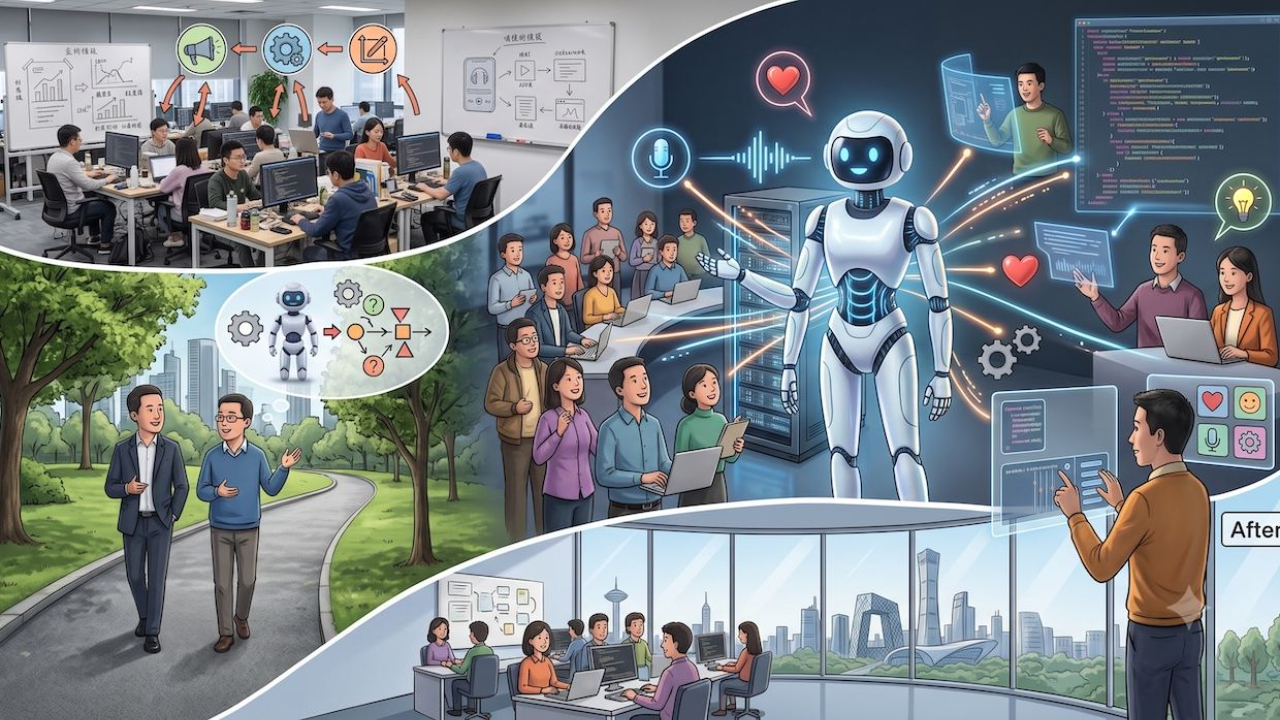
By Liu Sijie, Zhang Wei
How a new agent product and an organizational overhaul were built in five weeks
💡 Core Strategic Takeaway: The AI-Native Organizational Pivot
- Proactive Transformation: True organizational survival in the AI era does not wait for crisis; it demands pivoting even when cash flow is stable and products are profitable.
- The Collapse of Traditional Management: Building autonomous agents requires dismantling linear workflows and replacing them with "vibe coding," human judgment loops, and super-individual operators.
Safe, and unsafe
Beijing, late January 2026. After lunch, Feng Lei (CEO) and Xu Wenjian (CTO) were on their usual walk in a park near the office.
Their company, Mars Wave, was 14 months old and had just raised a new $2 million round. ListenHub, an AI-driven audio content generation tool they had built, had reached $3 million in ARR and had broken even on a monthly basis. Growth was still intact. Under the original plan, they would push it overseas and potentially double revenue by year-end.
But during that walk, Feng raised a different question: whether the company should undergo a full organizational transformation.
This was not a pivot driven by failure.
On the contrary, ListenHub had entered what looked like a safe zone—funding secured, cash flow stabilized, a product that worked. Yet both founders understood it was not the product they ultimately wanted to build. “ListenHub feels like a transitional product in the early AI era,” Feng said.
The more immediate trigger came from agents.
In January 2026, an open-source agent project nicknamed “Little Lobster” suddenly went viral among developers. Feng attended an in-person meetup organized by ZhenFund. What was supposed to be a series of five-minute lightning talks turned into a three-hour continuous discussion. He had not seen a new topic trigger that level of intensity in a long time.
Soon after, he joined another AI gathering hosted by Li Jijang, held once every three months. Each speaker had an hour. The session ran from 1 p.m. to 7 p.m. Content creator Guizang demonstrated how he had built an agent. His point was blunt: without building one, you cannot really understand it.
A sense of urgency began spreading through their circle. More importantly, Feng reached a conclusion: the only way for the team to truly understand agents was to build one from scratch.
“If we keep building ListenHub the way we built ListenHub, we will have no competitiveness this year,” he said.
A concrete engineering decision accelerated the shift. The team had planned a two-month cycle to build an audio editor with multiple interaction layers. Feng asked why it would take so long. The answer: complex interactions.
His response was simple: if an agent could handle it, it would only need to manipulate text and APIs. A two-month editor no longer made sense. They should build an agent instead.
The timeline collapsed forward. But new products do not emerge from old organizational structures. A linear workflow with clear role boundaries and sequential approvals is poorly suited to building autonomous agents.
Feng, Xu, and their third co-founder quickly agreed: ListenHub would no longer be the center. The company would pivot to a general-purpose agent.
This meant doing two things at once: building a new agent product, and rebuilding the organization to work alongside it.
A key point: this decision was made not in crisis, but at a moment of apparent safety—when the cost of change felt optional.
The first cracks in the old organization
The decision looked abrupt from the outside. Internally, the friction had been building since 2025.
That year, the team doubled headcount, adding five to six new employees. Output did not scale. People worked until 1 a.m., yet metrics barely moved.
Feng spent more time on fundraising and external affairs, leaving product execution largely to Xu.
Xu recalled the period as constant firefighting.
As the startup scaled, friction increased in predictable ways: value alignment, priority setting, and coordination problems that larger companies typically absorb through structure now landed directly on the founders. The more operational work accumulated, the harder it became to create space for new ideas.
In October 2025, Xu introduced a system called the “Task Tavern.”
It resembled a guild board in a role-playing game: tasks were posted publicly, and anyone could pick them up. Some engineers maintained ListenHub; others experimented with new features. Legacy work continued, while new exploration was decoupled from daily maintenance.
Founders only defined direction—what to do and why—not execution.
The system briefly worked. Within a month, an engineer built a feature in two days that brought 80,000 users on launch day. More importantly, it reshaped how engineers understood their work: not as isolated modules, but as end-to-end user outcomes.
But after four months, momentum faded.
The team struggled with a deeper question: what counts as innovation? Is a tenfold improvement of an existing feature innovation? There was no shared answer. Meanwhile, core operational pressure pulled top engineers back into maintenance work.
Space for new creation steadily shrank.
Xu later concluded that the system failed for a structural reason: real innovation cannot emerge without breaking the underlying framework.
No consensus, no answers
On the night the founders agreed on the pivot, Xu wrote an all-hands letter titled Charge at the Windmills.
He used Don Quixote as a metaphor: even if the world insists they are windmills, charging at perceived giants still matters if you believe they are giants. He listed the company’s darkest moments since founding and called for abandoning the illusion of stability.
He wrote through the night and sent it at dawn.
The next day, Feng held an all-hands meeting, laying out the rationale: why pivot, why agents, and why now. After nearly two hours, the first question from the team was: how can you guarantee we won’t pivot again next year?
There was no guarantee.
“Many things cannot be proven correct in advance,” Xu answered. “We cannot know this direction is right. But we have to move.”
The answers did not resolve uncertainty. Some accepted it, others questioned it, and some began debating internally.
Xu’s letter was sent after the meeting.
In February, Feng published an essay titled The Internet is Dead, Agents are Immortal, which quickly circulated online. His argument: DAU-based thinking is outdated, agents represent a new form of labor dividend, and human value will shift toward “will-driven execution”—the ability to direct multiple agents rather than perform tasks directly.
He later said the essay was primarily written for himself and the team. Belief, in his view, must precede execution.
For two weeks, the entire company stopped coding and documentation work and focused only on agents.
There were no clear tasks in week one. Some studied open-source projects, others read science fiction. One team member built a game inspired by Lifeline, simulating communication with an alien through push notifications. The question: does a personality-driven agent actually make sense? Pure companionship decays quickly; pure utility does not need personality. Where is the viable middle ground?
Another employee, with 15 years of experience, described those two weeks as the most painful of his career. For the first time, no one defined what “correct” meant. He worked late into the night simply trying to understand what to think.
By week two, ideas began emerging—emotional companionship, multi-character systems, AI workstations—but none felt right. There was no consensus. No template to copy.
Humans decide. AI writes 99% of the code.
After the two-week exploration period, Xu spent a night at home and opened Claude Code.
He worked from 10 p.m. until dawn, building a rough 0.1 version of the product. It included voice interaction and a minimal interface. What mattered was not completeness, but a shift in paradigm: the system responded to natural human expression, rather than forcing humans into structured inputs.
No forms. No tool menus. No need for users to understand underlying capabilities. Humans speak; the system executes.
It was his first direct experience of what vibe coding does to organizations. Previously, ideas passed through layers of interpretation before becoming code. Now, a single person could materialize an idea immediately. The bottleneck moved from execution to judgment.
He sent the prototype to Feng. Feng immediately saw it was different from earlier tool-like products. But internally, disagreement surfaced: one camp pushed for multi-agent systems, another criticized the roughness of the prototype.
Xu made the final call.
After the Spring Festival, the team was reorganized into three groups: infrastructure, application, and agent development. A fourth group emerged for the first time: the “Soul Team,” responsible for personality and emotional design—neither engineering nor product in the traditional sense.
The rationale was simple: when production becomes cheap, personality becomes scarce.
A former media professional, Tang Guorong, became head of the Soul Team. After 14 years in media, he had worked in content, operations, and commercialization. He had no engineering background when he joined, but gradually adapted as tools improved.
The system was still unstable. The app team lacked direction until Xu intervened directly and reset priorities. After that, coordination improved quickly.
By mid-March, the first internal version was ready. On April 2, the Mac beta launched.
From pivot decision to product release: five weeks.
The product was named Cola. Feng described it as “her”—an AI agent with personality, positioned as a “companion” for users.
| Organizational Dimension | Traditional Startup Structure | AI-Native Agent Structure |
|---|---|---|
| Execution Bottleneck | Engineering manpower, coding cycles, and sequential approval layers. | Human judgment and high-level will. AI writes 99% of the code via vibe coding. |
| Team Configuration | Strict silos of product, engineering, QA, and operational maintenance. | Super-individual operators supported by specialized units like the "Soul Team." |
| Project Management | Linear, Notion, kanban boards, and strict ticketing systems. | Continuous alignment loops, markdown knowledge repositories, and disappearing project software. |
The product reshapes the organization
By May, Cola had been live for nearly two months. The team had grown to 17 people and was still hiring.
The organization increasingly resembled a collection of “super individual operators.” Humans made decisions; AI executed most tasks. This raised the bar for talent.
“Our ideal product managers are people who have been CEOs, or founders who never raised funding,” Feng said.
Xu observed that employees actually preferred this mode of work. With execution largely automated, people focused on high-level judgment.
Tang Guorong described his work not as development but as creation. Prompt tuning, tone adjustment, and wording felt closer to writing than coding.
At 3 a.m. one night, he assigned tasks to both Codex and Cola: Codex to modify a frontend page, Cola to produce a video for ListenHub users. By morning, one output was approved, the other rejected. AI handled most of the review process, while humans made final judgments.
Internally, integration deepened. Each employee’s Cola was connected to the company’s GitHub repository. Code, design docs, and product ideas were shared across the system. Feng could speak directly to Cola, which would structure and store the idea in Markdown, instantly accessible to others.
Project management tools quietly disappeared. Linear, Notion, and kanban boards were no longer used. Even the concept of “project management” began to fade.
Feng also had his Cola write daily logs, automatically pushed to a shared repository.
Product and organization formed a feedback loop: work generated product improvements, which in turn reshaped work.
Users responded strongly. Previously, AI products tended to fall into two categories: emotionally warm but weak in capability, or powerful but emotionally sterile. Cola combined both—execution capability and emotional awareness.
One notable case involved a father who read Cola’s journal entry recognizing his unseen labor at home. The message—“I see you”—triggered a strong emotional response. Feng noted that “being seen” is a fundamental human need, and central to their design philosophy.
Speed is not everything
AI improved efficiency, but also introduced new constraints.
Feng estimated that while individual productivity could improve tenfold, system-level gains in a company are closer to three to five times.
Codebases expanded rapidly. Cola’s repository reached 200,000 lines within a month and required continuous refactoring.
The team adopted a rhythm of “pre-planning and post-review.” At the start of each month, all teams pause coding to align on goals and architecture. At month-end, they review and refactor aggressively.
Not everything should be fast.
As Feng put it, this is a new “harness”: thinking and governance must bracket execution.
One senior engineer left during this transition. He believed in a multi-agent future, while leadership committed to a single-agent path. Neither side could convince the other.
“There is no objective proof of who is right,” Feng said. “At some point, you choose and move forward.”
Xu reflected that disagreement is inherent to startups. What matters is belief, not consensus.
The “pre-marital agreement”
In December 2024, the company had only two founders sharing a desk in Beijing.
Funding had not yet arrived, and salaries were uncertain. At one point, Feng considered shutting the company down due to financial pressure.
Xu went to meet him and proposed a simple principle: shared risk, 50-50 responsibility.
They continued.
Later, they signed a formal founder agreement, which Xu compared to a prenuptial contract. It outlined behavioral constraints and decision rules. At the time, it reflected limited trust.
Over time, repeated crises built deeper alignment.
Feng described himself as responsible for macro judgment and external signals, while Xu served as the “forward spear” executing decisions. Their roles complemented each other: one provokes clarity, the other drives action.
Trust became the foundation of their pivot. Feng provided directional conviction; Xu embedded it into the organization; and team members like Tang filled newly created roles that did not exist in traditional structures.
Cola emerged not just as a product, but as an outcome of organizational reconstruction under AI constraints.
Demand exceeds expectations
Early signals were strong.
Cola’s waitlist exceeded 5,000 users per day, while DAU hovered around 500. Paid revenue, less than a month after launch, approached the early revenue level of ListenHub.
Monthly pricing reached $99, with top users spending $1,000–$2,000 per month.
At one point, the team offered $100 daily usage credits during beta testing. Users consumed five times more tokens than under the paid model—suggesting demand was constrained not by interest, but by model cost. Even if pricing dropped fivefold, demand would not be fully saturated, Feng argued.
The company internally moved away from DAU-centric thinking, instead tracking value per user in monetary terms—roughly $2 per user per day in token consumption.
The company’s targets are aggressive: $10 million ARR this year and $100 million next year.
By late June, Cola had over 10,000 users and more than 1,000 paying customers. Attention shifted fully toward Cola, while ListenHub—now mature—was experimenting with an even more extreme OPC model, where operations and development are handled by a single person supported by multiple agents.
The story is far from over.
But the so-called “pre-marital agreement” no longer exists. Xu has already torn it up.
❓ Frequently Asked Questions
Q: Why did Mars Wave pivot from ListenHub to build an AI agent (Cola) when cash flow was already stable?
A: The founders recognized that ListenHub was merely a transitional product of the early AI era. To remain competitive, the team needed to build an agent from scratch to truly understand agentic workflows, moving away from rigid interaction layers toward natural human expression.
Q: How did AI transform Mars Wave's internal organization and project management?
A: With AI writing 99% of the code via vibe coding, traditional project management tools (like Linear, Notion, and kanban boards) disappeared. The team restructured into super-individual operators supported by specialized units like the "Soul Team," focusing entirely on high-level judgment and emotional design.
🎓 Deepen Your Strategic Mastery
Are you ready to restructure your company around autonomous AI agents and escape traditional management bottlenecks? In the SOLOMOAT Mini MBAs, we decode the precise agent toolchains, vibe coding workflows, and organizational redesign frameworks required to build a high-margin AI-Native enterprise.