
AI has finally begun to pay for itself.
Jul 17, 2026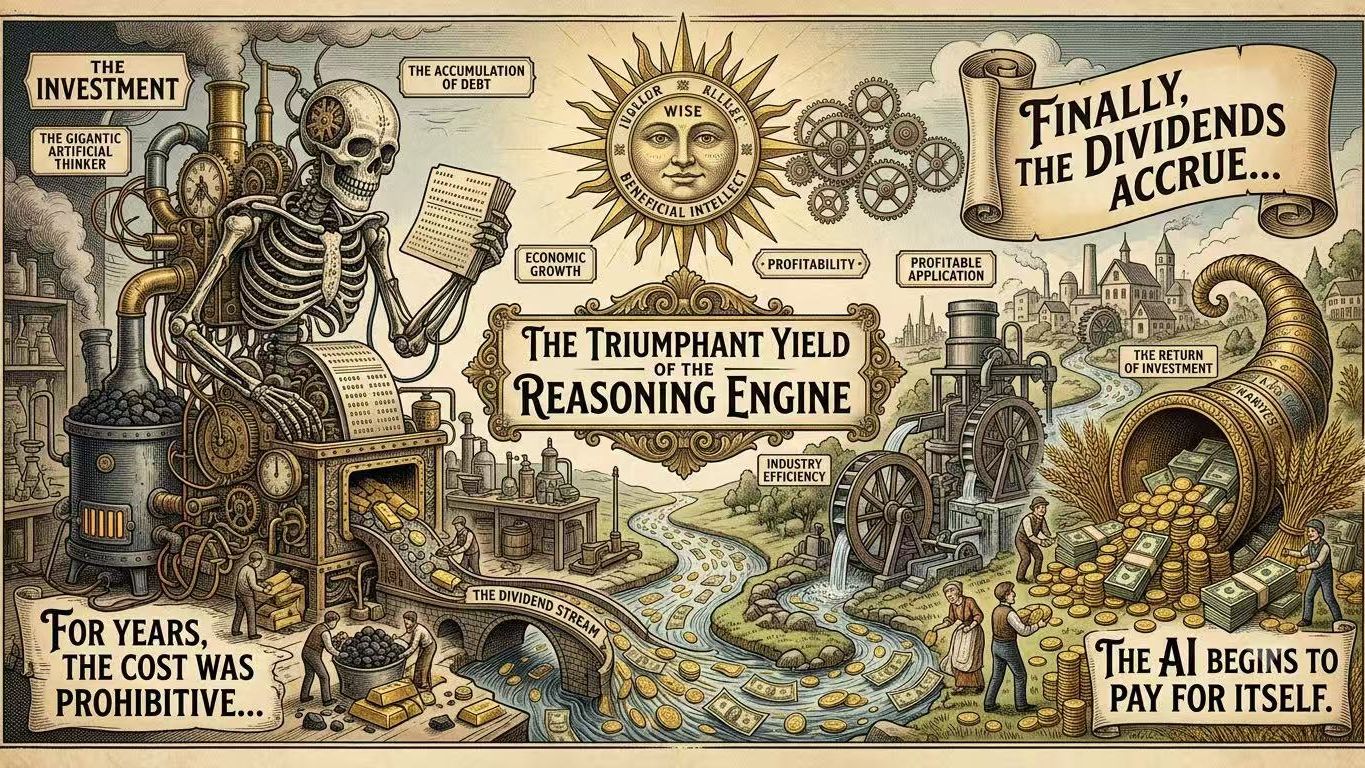
By Garbo Tian
Over the past two years, the global debate on artificial intelligence has barely paused. On one side, tech giants have repeatedly reset records in capital expenditure. On the other, markets keep asking a basic question: when will these investments generate sufficient commercial returns?
Against this backdrop of dot-com bubble comparisons, a set of seemingly ordinary financial figures has become a critical signal of whether AI has crossed its commercialization threshold. When AI-generated revenue first begins to cover the depreciation of its own infrastructure, the debate shifts. The question is no longer whether AI has a future, but whether it can sustain a viable profit model.
💡 Quick Takeaways: The AI Financial Inflection Point
- The Inflection Point: For the first time, global generative AI revenue ($25 billion) has exceeded estimated quarterly infrastructure depreciation ($21 billion). Compute is no longer purely a sunk cost.
- The Paradigm Shift: The AI market is transitioning from "Compute Scarcity Pricing" to "Return-on-Capital Pricing." The advantage belongs to those who own intelligent capital rather than traditional labor inputs.
1. The Collapse of a Wealth Narrative and Accounting Rewiring
Over the past two years, the deepest fault line in the AI super-cycle has not been technical performance. It has been a far more prosaic issue: whether the towering infrastructure capex can ever be recovered. Short sellers have repeatedly raised the "AI revenue gap," arguing the system resembles an unsustainable hardware-driven Ponzi structure.
A quiet accounting inflection point is now emerging. In capital-intensive accounting terms, "revenue exceeding depreciation" is a hard threshold. It implies that AI infrastructure has passed its first serious financial stress test. It is no longer purely a cash-burning story, but has begun to exhibit the early structure of a self-sustaining system.
Key Data Node: The Q1 2026 CrossoverAccording to State of the AI Economy (June 2026), global generative AI revenue outside China reached $25 billion in Q1 2026. Over the same period, estimated quarterly depreciation tied to AI models and data centers stood at roughly $21 billion. Through token usage, subscriptions, and APIs, compute is being converted into cash flow at scale.
2. Three Financial Lenses on AI Restructuring
To understand what this inflection point actually means, the headline numbers must be decomposed. AI has crossed the “hardware depreciation survival line,” but it remains far from self-sustaining free cash flow due to massive electricity, cooling, and debt-servicing burdens. This turning point marks the transition away from legacy valuation frameworks.
| AI Cycle Phase | Valuation Regime | Market Focus |
|---|---|---|
| Stage 1: (2023–2024) | Compute Scarcity Pricing | Markets rewarded access to GPUs. Whoever secured chips captured valuation premiums (e.g., Nvidia’s trillion-dollar ascent). |
| Stage 2: (2024–2025) | Capital Expenditure Pricing | Valuation shifted toward balance-sheet strength: the ability to spend on compute, secure green power, and build high-density data centers. |
| Stage 3: (Q1 2026+) | Return-on-Capital Pricing | Translating compute investment into high-margin inference revenue, enterprise stickiness, and productivity flywheels. |
3. Pricing Power in the Age of Intelligent Capital
Behind revenue surpassing depreciation lies a new set of rules governing value creation. For investors, founders, and policymakers, particularly in global capital hubs such as Hong Kong, the implications are structural.
- Focus on Productivity Flywheels: The dominant source of valuation premium will no longer be scale in compute deployment, but the ability to convert intelligent capital (compute, data, energy) into sustained cash flow.
- Ownership Over Labor: If AI systems can "pay for themselves," digitally mediated labor has achieved a closed commercial loop. Wealth is shifting toward owners of intelligent capital; equity participation matters more than job skill level.
- Assetizing Infrastructure Returns: Hong Kong’s role as a global financial hub will evolve. Compute revenue rights or data asset securitization will become part of a new financial architecture, moving beyond traditional three-year profit histories.
The assumption that human labor is the sole source of wealth is no longer intact. A new regime—defined by productivity, algorithmic coordination, and compute-energy coupling—is taking shape through the cold arithmetic of accounting statements.
❓ Frequently Asked Questions
Q: Why is the AI revenue vs. depreciation crossover a critical milestone?
A: It proves that AI infrastructure has passed its first major financial stress test. When generative AI revenue exceeds the depreciation costs of its GPU clusters and data centers, it demonstrates that compute is successfully being converted into paid economic output, countering the narrative that AI is merely a hardware-driven Ponzi scheme.
Q: Are AI companies now highly profitable because revenue exceeds depreciation?
A: Not entirely. While crossing the depreciation threshold is vital, depreciation is only the first layer of costs. Companies still face massive operating burdens, including electricity, cooling, R&D, and debt-servicing expenses. AI has achieved "hardware survival," but remains far from generating self-sustaining, high-margin free cash flow.
🎓 Deepen Your Strategic Mastery
In the tactical sandboxes of the SOLOMOAT Mini MBAs, we decode the underlying business logic behind global asset strategies and macroeconomic shifts. We teach you how to see through market illusions and master the new rules of value creation in the age of intelligent capital.