What Is the Biggest Dividend for Individuals in the AI Era?
Jul 21, 2026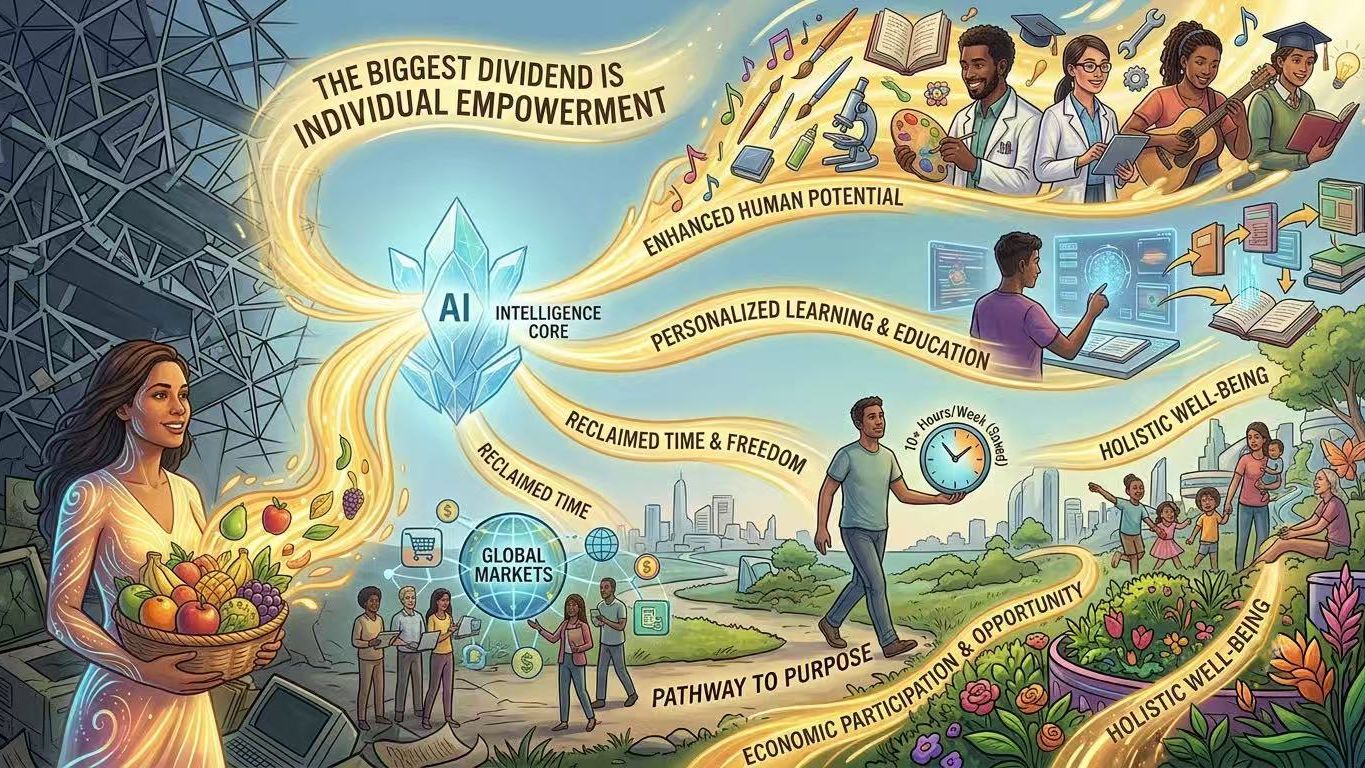
By Garbo Tian
The Cognitive Evolution: Moving Beyond Information Retention
In recent years, "recording" has quietly become a cultural habit. Some people keep daily journals. Others shoot vlogs, build knowledge cards, post regularly on social media, run public accounts, record podcasts, capture voice notes, or write morning pages.
At first glance, these practices are usually interpreted as a form of information retention—recording in order not to forget, to accumulate insights, or to produce content. But a closer look at people who sustain high-frequency recording over long periods reveals that what actually changes is not the volume of output, but the structure of cognition itself. Their most significant shift is neither improved writing nor better expression, nor even audience growth. It is a restored sense of control over life.
What this discussion is really about is not "recording" per se, but a deeper issue: the management of awareness.
💡 Quick Takeaways: The Power of Cognitive Offloading
- The Brain's Limitation: The human brain is an exceptional processing engine but a poor storage unit. Forcing it to hold data creates massive operational drag.
- The AI Dividend: The ultimate dividend of the AI era is not content generation—it is cognitive offloading. By migrating storage to AI, you free your mind to upgrade into higher-level metacognition and strategic self-awareness.
1. The Illusion of Memory vs. True Processing Power
Most people do not realize that the human brain carries a structural limitation. Very few individuals can retain dozens of running items in their working memory simultaneously without dropping clarity. When we force our minds to serve as file cabinets—constantly trying to remember calendar events, content ideas, and analytical frameworks—we systematically degrade our ability to perform high-value processing.
By writing everything down and mapping thoughts continuously, you are not merely keeping archives. You are executing an externalized clearance. You are telling your brain: "This data is safely stored outside; you are now free to analyze it without the fear of losing it."
2. Upgrading the Architecture: Storage Layer vs. Processing Layer
In the AI era, this externalization is amplified exponentially. If you treat your personal knowledge base and AI tools as an extended neocortex, your dynamic efficiency changes entirely. Below is how the cognitive distribution shifts when you stop using your mind for raw data storage.
| Cognitive Layer | Traditional "Brain-As-Storage" Model | AI-Driven "Cognitive Offloading" Model |
|---|---|---|
| Data Storage | Internalized. Relies on organic recall, causing heavy mental anxiety and data decay. | Externalized. Transferred to personal databases and AI agents (Lossless & Instant). |
| Mental Bandwidth | Severely clogged by logistical tasks, low-level details, and data maintenance. | Completely liberated. Maximized for pattern recognition, intuition, and creation. |
| Metacognitive Level | Low. Trapped in responsive loops and firefighting daily inputs. | High. Enables systemic observation of one's own behavioral and market biases. |
3. The Ultimate AI Dividend: Metacognitive Mastery
The real divide in the AI era will not be between those who can write code and those who cannot. It will be between those who remain trapped in the mechanical layers of execution and those who successfully step up to the metacognitive layer.
When your personal knowledge system seamlessly captures, tags, and organizes the noise of the external world, your mind undergoes a structural upgrade. You transition from being an anxious content assembler to an elite systems architect. You stop merely reacting to inputs and start intentionally designing your focus, your business moats, and your life metrics.
❓ Frequently Asked Questions
Q: Why is high-frequency recording closely tied to a sense of control over life?
A: High-frequency recording acts as an externalized cognitive clearance. When thoughts are safely mapped outside the organic mind, it systematically alleviates the fear of information loss, returning your brain to its optimal processing state and restoring control over your mental focus.
Q: What is the biggest individual dividend in the AI era?
A: The biggest dividend is not leveraging AI to churn out higher volumes of text, but using AI for complete cognitive offloading. By delegating low-level data retention to technology, individuals can upgrade their operational focus to high-level pattern recognition and metacognitive mastery.