Jailbreaking Apple and Google: ByteDance’s “Ultimate Operating System” Delusion and the Vanishing Frontiers of the AI Era
Jul 25, 2026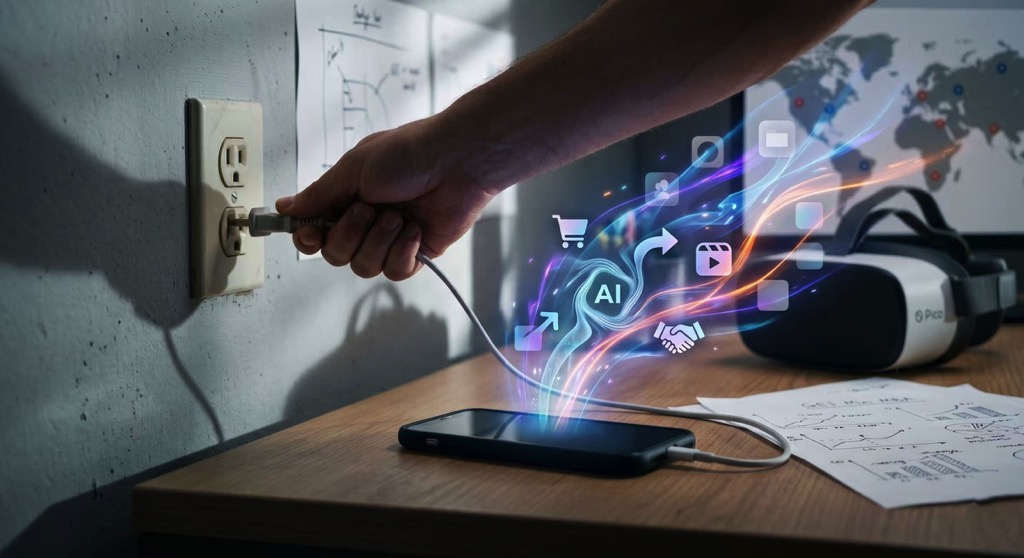
By Garbo Tian
Why does ByteDance endure staggering losses to acquire VR hardware (Pico) and pour capital into large-scale models? This is no mere trend-chasing; it is the payment of a "survival option fee." As long as ByteDance operates within the iOS and Android ecosystems, its throat remains firmly in the grip of Apple and Google. It is compelled to seek out the next generation of computing platforms to establish its own physical beachhead.
What is the ultimate destiny of the "Super-App"? They do not aspire to be the next Facebook or Google; they crave to become the "next-generation operating system (OS)." When an app commands 30% of your time, governing your consumption, entertainment, and mobility, it becomes—to your brain—the operating system itself; the smartphone hardware is reduced to nothing more than a power socket.
How will generative AI reconfigure the boundaries of human-computer interaction? Large AI models will serve as the ultimate adhesive, dissolving the barriers between apps. Future interaction will shift from clicking disparate applications to issuing natural language commands (intent-based). AI assistants will operate at the base layer to handle meal orders, ticket bookings, and content generation, effectively severing the traffic gateways of traditional internet titans.
💡 Core Strategic Takeaway: The Ultimate Jailbreak
- The House Arrest: Being a highly profitable tenant on iOS and Android means a single privacy policy update can wipe out billions in ad revenue.
- The Dimensional Strike: ByteDance is using AI (intent-based interaction) and hardware investments to hollow out traditional apps, turning itself into the universal digital assistant that governs all sensory inputs.
1. The Vanishing Frontiers of the AI Era
Put away your microscope and replace it with a high-powered telescope. For years, we have been accustomed to dissecting ByteDance’s addictive recommendation algorithms and its pervasive global expansion as if scrutinizing the gears of a Swiss watch. But today, I must posit a chilling hypothesis—one that sounds like science fiction yet concerns the existential survival of the global tech landscape: hidden behind the flamboyant icons of Douyin or TikTok is not merely entertainment software designed to coax two more minutes of dancing videos from you.
Its ultimate delusion is a jailbreak. It seeks to escape the house arrest imposed by Apple and Google, becoming the "next-generation operating system (OS)" that takes over your entire sensory and command input. While you fret over the daily share price fluctuations of Silicon Valley giants, a super-beast from the East is quietly orchestrating an ultimate "dimensional strike" aimed at erasing all physical boundaries between apps.
2. Paying the "Survival Option Fee" to Seize Interaction Hegemony
For macro-strategists and investors well-versed in geopolitics and technology cycles, failing to grasp this visceral fear of being "strangled" makes it impossible to decipher the seemingly irrational cash-burning maneuvers of today’s tech giants.
ByteDance’s greatest current vulnerability is that its multi-hundred-billion-dollar prosperity is built upon someone else’s foundation. A slight tweak to iOS privacy tracking by Tim Cook or an adjustment of Android permissions by Google could trigger a seismic shift in ByteDance’s advertising empire. To break free from this humiliating parasitic state, Zhang Yiming has unhesitatingly sunk massive capital into acquiring Pico (VR hardware) and placing heavy bets on generative large models (such as Doubao and Coze).
To the conventional investor, Pico’s lackluster sales are a financial failure; but to the elite strategist, this is the "survival option fee" required to secure a seat at the next-generation hardware table. The more lethal shift lies in AI: if ByteDance’s AI can not only "recommend" videos but also "understand" complex intent—autonomously generating code, ordering takeout, or scheduling itineraries—then traditional search engines and standalone apps will be completely bypassed. In this vision, it is no longer an application; it is the sole interface governing human physical and digital life.
3. Strategic Alpha: The Next-Gen OS Matrix
| The Vulnerability (Legacy Reality) | The Escape Plan (Strategic Play) | The Alpha (Ecosystem Monopoly) |
|---|---|---|
| The "Platform Dependency" Stranglehold: Commercial monetization is subject to the privacy and permission hegemony of Apple's iOS and Google's Android. | Paying the "Option Fee" for Hardware: Disregarding short-term losses to invest in spatial computing (VR/AR) to establish a proprietary physical entry point. | Shedding tenant status: Possessing absolute sovereignty in the spatial computing era. |
| Traffic Fragmentation from App Silos: Services are fractured across different apps, forcing users to endure high cross-application switching costs. | Reconstructing Interaction (Intent-Based AI): Using large models to understand and execute complex user commands via natural language, bypassing GUIs. | Elevating the Super-App into a "universal personal assistant," hollowing out rival traffic gateways. |
| Contentment as a "Traffic Middleman": Relying on distributing third-party content, constantly facing ecosystem stagnation and creator churn. | Transitioning to a "Next-Gen OS": Fusing algorithms, payments, hardware, and AI into the ultimate "black hole" for digital behavior. | Redefining the human connection to the digital world and capturing the ultimate monopoly premium. |
Closing Thought
If an application commands 30% of your day while seamlessly managing your meals, social life, and even your convictions, it is no longer merely an app. To your brain, dear friend, it is the operating system; that expensive handset in your palm is nothing but a socket used to keep it powered.
❓ Frequently Asked Questions
Q: Why is ByteDance investing heavily in VR hardware and AI language models?
A: It is a "survival option fee." ByteDance is highly vulnerable to Apple and Google's operating system policies. By investing in hardware (like Pico) and AI, they aim to build their own "next-generation OS" and escape this platform dependency.
Q: What does "intent-based" interaction mean for the future of apps?
A: Instead of manually clicking through multiple standalone apps, users will issue natural language commands to an AI assistant. The AI understands the "intent" and autonomously executes tasks (booking, ordering, researching), making traditional apps obsolete.
🎓 Deepen Your Strategic Mastery
The SOLOMOAT never deigns to rehash yesterday’s financial statements. In our Mini MBA forward-looking strategic simulations, we invite you to examine this century-long shadow war for operating system supremacy. We provide decision-makers with the intellectual keys to crack the endgame code of future tech oligarchs.