
Dismantling the Million-Dollar Robotic Arm: When the Crude Aesthetic of "Flesh and Fixture" Humiliated Tokyo’s Automation Fever
Jul 27, 2026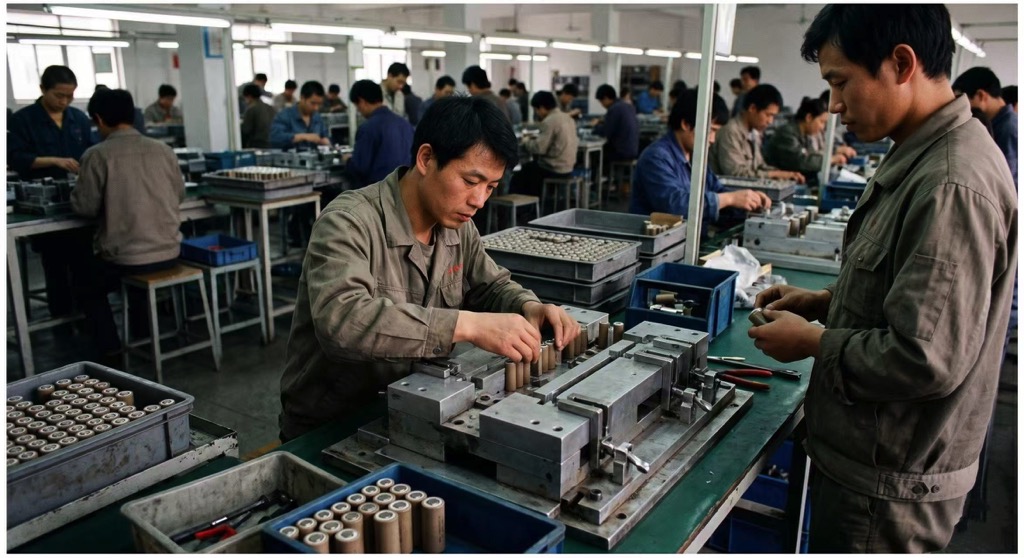
By Garbo Tian
By Garbo TianWhy did BYD dismantle expensive imported automated robotic arms? The exorbitant cost of a robotic arm lies in its integration of sensing, judgment, and high-precision locking functions. Through engineering deconstruction, Wang Chuanfu discovered that a combination of "human plus fixture" could achieve identical manufacturing precision: the fixture provides the physical limitation (precision), while the human provides the movement (power), thereby completely circumventing the costly procurement of automation equipment.
How devastating is the financial impact of this "crude method"? It results in extremely low capital expenditure (CapEx). BYD established a production line capable of daily outputting 20,000 batteries at a cost only one-fifteenth that of its Japanese peers, granting its products a crushing price advantage from the very first day of market entry.
Why did "flesh and fixture" ultimately triumph over Japanese flexible manufacturing? Specifications in consumer electronics change in the blink of an eye. When Motorola requested a change in battery dimensions, Japanese automated factories required months of downtime for reprogramming and the replacement of expensive robotic arms; BYD, by contrast, needed only a few late nights to replace several dirt-cheap physical fixtures before resuming production.
💡 Core Strategic Takeaway: The Deconstruction of Capital
- The Automation Fetishism: Blindly worshipping expensive machinery traps companies in crushing fixed-asset depreciation and fragile cash flows.
- The Physical Limiters: Substituting million-dollar sensor arrays with low-cost human kinetic energy and high-precision physical fixtures shatters traditional CapEx barriers, creating an invincible cost moat.
1. The Heresy in the Cleanroom
Imagine the boardrooms of Sony or Sanyo in Tokyo during the early 1990s. Executives were effectively worshipping the unerring German robotic arms within their cleanrooms. In the industrial bible of that era, automation equaled efficiency, while labor equaled risk. If one wished to venture into battery manufacturing, the price of admission was tens of millions of dollars in capital expenditure. At this moment, a young Chinese man with only 2.5 million RMB in his pocket walked into the casino. According to McKinsey’s financial models, he should have declared bankruptcy on day one.
Yet, rather than weeping outside the ramparts of capital-intensive industry, Wang Chuanfu performed a heretical act that sent shivers down the spines of his Japanese counterparts: he gritted his teeth, purchased an imported robotic arm worth millions—and then ruthlessly tore it to pieces. This was no Luddite destruction; it was a cold-blooded deconstruction of the fetishism surrounding automation, an event worthy of the annals of global industrial history.
2. The Mathematics of "Robot = Human + Fixture"
For those global executives, private investors, and curious polymaths who fret daily over a few percentage points of depreciation within multinational supply chains, BYD’s "human plus fixture" model serves as the most caustic satire of "capital-centrism."
We are perpetually brainwashed by a flamboyant technocratic fetishism, believing that more expensive machinery represents higher productivity. But in Wang Chuanfu’s equation, "Robot = Human + Fixture." He pierced the financial bubble of automation with acute precision: since one cannot afford robotic hands capable of precise gripping, one should instead design a set of high-precision physical fixtures, allowing low-cost workers to provide merely the kinetic energy for transport.
This manufacturing model, seemingly crude and redolent of heavy sweat, was in fact a high-end innovation in capital efficiency. It not only slashed the cost of establishing production lines to one-fifteenth of the Japanese competition but also demonstrated an agility—when faced with the fickle orders of Nokia and Motorola—that even the most elite Japanese flexible production lines could not hope to match. In this volatile commercial world, rigid heavy assets are often the meat-grinders of profit, while the seemingly clumsy "flesh-and-blood system" becomes the highest-leverage tool for arbitrage.
3. Strategic Alpha: The Cross-Industry Disruption Matrix
| The Trap (Legacy Model) | The Strategic Play (Systemic Shift) | The Alpha (Structural Dividend) |
|---|---|---|
| Blind worship of "capital-intensive" automation: A fetish for the perceived perfection of expensive machinery, leading enterprises to shoulder crushing fixed-asset depreciation and leaving cash flows extremely fragile. | Dismantling the black box to execute "functional substitution": Deconstructing expensive automated processes into minute, independent movements, replacing complex electronic control units with ultra-low-cost physical structures (fixtures). | Bypassing the "cash-burning dead-end" at the startup phase, establishing a cost moat with absolute, overwhelming price advantages at one-fifteenth the capital expenditure. |
| "Turning paralysis" caused by heavy assets: When customer demands shift abruptly, highly integrated automated lines require long and expensive reprogramming and hardware replacement, leading to delivery defaults. | Utilizing "humanity" as the ultimate flexible variable: Leveraging the extreme flexibility of human resources, combined with rapidly and cheaply replaceable fixtures, to create "fluid production lines" capable of reconfiguration at any time. | Perfectly adapting to the short and volatile order cycles of the consumer electronics era, using "mercurial" agility to drain the market share of traditional giants. |
| Viewing labor as a "low-end risk": The Western industrial complex overstates the error rates of manual operation, attempting to use expensive silicon-based machines to entirely eliminate carbon-based life. | Taming manual error through "physical limiters": Relying not on the intuition or experience of workers, but on the physical positioning of precision fixtures to take over manufacturing accuracy, achieving high-quality consistency at low cost. | Achieving an improbable unification of "high-quality standards" and "ultra-low manufacturing costs" during the labor dividend period. |
Closing Thought
The Niche Hunter operates perpetually like a radar gliding through the dark web of capital, specifically capturing these counter-intuitive, anti-dogmatic, and hidden arbitrage opportunities for you. Within the elite circle of the SOLOMOAT, through in-depth simulations, we lead you to appreciate this violent aesthetic—the perfect stitching of physical principles and human resources—ensuring that your enterprise possesses the absolute confidence to "shatter and reorganize" when faced with expensive Western industrial standards.
Join the SOLOMOAT to decrypt the corporate developmental DNA of this "Nation of Engineers."
❓ Frequently Asked Questions
Q: How did BYD achieve high precision without automated robotic arms?
A: Through "functional substitution." Instead of using expensive sensors and electronic control units, BYD designed high-precision physical fixtures. The fixture dictates the exact physical limits (precision), while manual labor simply provides the kinetic energy to move parts into place, taming human error entirely.
Q: Why is heavy automation sometimes a liability in consumer electronics?
A: Consumer electronics feature short, volatile product cycles. When specifications (like a battery size) change unexpectedly, highly integrated automated lines suffer from "turning paralysis," requiring months of downtime and expensive reprogramming. A human-and-fixture line can be reconfigured overnight simply by swapping out cheap physical clamps.
🎓 Deepen Your Strategic Mastery
Are you blindly trusting standard financial models while true innovators rewrite the rules of your industry through structural disruption? In the SOLOMOAT Mini MBAs, we decode the precise operational frameworks, capital-efficient disruption strategies, and counter-intuitive insights required to dismantle legacy monopolies.