Haidian: Building an “Innovation Operating System” for the AI Super-Individual
Jul 30, 2026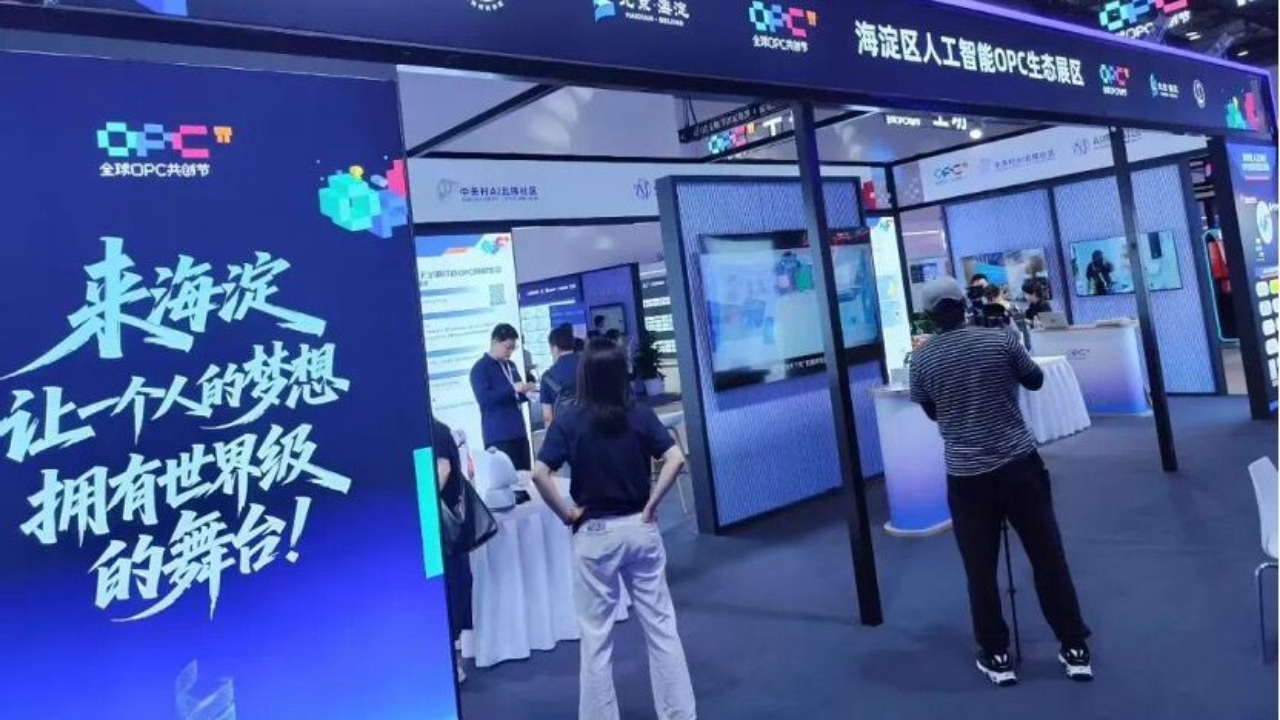
By Garbo Tian
In the summer of 2026, at the Haidian exhibition zone of the Global Digital Economy Conference and Digital Economy Industry Expo, one slogan was repeatedly photographed and circulated: “Come to Haidian, and let a one-person dream have a world-class stage.”
It was not mere rhetoric. Inside and around the booth, visitors witnessed a series of working prototypes that suggested a new entrepreneurial unit is already taking shape.
A classically trained Chinese instrumental musician used a vision-based foundation model to compress the task of converting five-line staff notation into numbered notation from hours to roughly one minute. A materials science PhD, back in China for less than a year, signed nearly RMB 30 million in contracts using an “industrial AI brain.” A tiny team spun out of a lab applied reinforcement learning to control problems in fusion energy systems.
They share a name: OPC — One Person Company, a new entrepreneurial form enabled by artificial intelligence, in which a single individual operates as a full-stack production unit.
Haidian’s ambition is not limited to providing office space or startup subsidies. It is attempting something closer to an operating system for innovation: precision policy “irrigation,” tightly coupled spatial communities, and coordinated institutional mechanisms designed to ensure that ideas can be tested and scaled at minimal cost and maximum speed.
The question is how this system actually works. The exhibition reveals a distinct ecological logic.
💡 Core Strategic Takeaway: The Innovation Operating System
- From Subsidies to Infrastructure: Haidian is redefining government support by shifting from simple capital injection to providing a complete "operating system"—where policy tracks growth, physical space enables connection, and structural mechanisms remove scaling friction.
- The Individual as the Ultimate Unit: Recognizing that AI drastically reduces team-size requirements, institutions are completely reorganizing their ecosystems around the "Super-Individual," transforming isolated creators into powerful economic agents.
1. Strategic Choice: Why OPC?
Haidian’s bet on OPC is not a reaction to fashion.
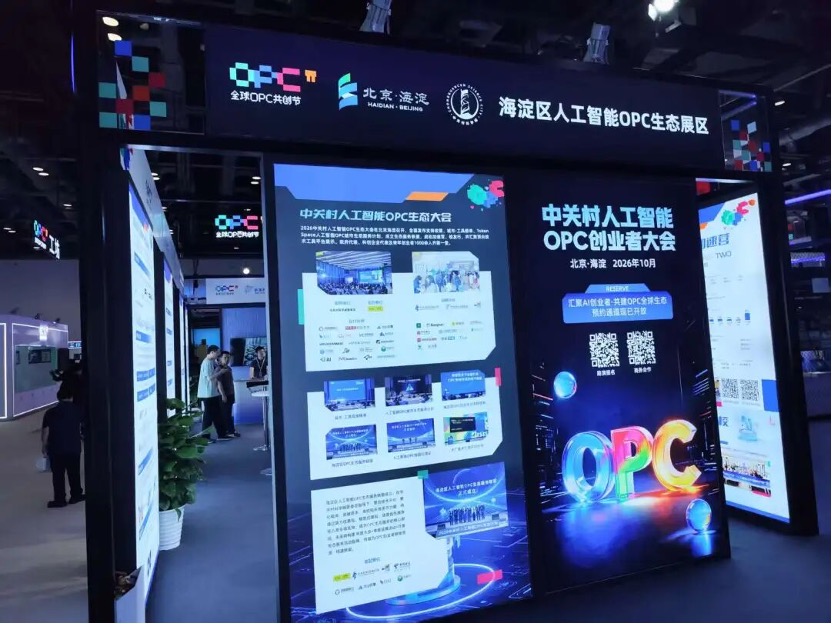
Large language models and AI tooling have sharply reduced both technical barriers and team-size requirements. A single person, combined with open-source models, can now build products capable of serving millions of users.
Haidian also holds structural advantages: approximately 90,000 AI professionals, the highest concentration of top-tier academics in China (around 40% of the national total), and one of the country’s most active technology ecosystems with diverse application scenarios.
Reframing the individual as the smallest unit of innovation — and reorganizing institutions around that unit — is Haidian’s response to how industrial organization is being rewritten by AI.
But talent density does not automatically produce OPC formation. To move an individual from idea to product requires system-level support.
Haidian’s answer is structural: policy as needle, space as thread, mechanism as loom — weaving a network that is both load-bearing and elastic.
At the 2026 conference, a Haidian official summarized it bluntly: the goal is not “investment attraction,” but ecosystem cultivation — enabling any AI builder to validate and scale ideas at the lowest possible cost and highest possible speed.
This reflects an institutional shift: Haidian is no longer positioning itself merely as a technology cluster, but as an innovation operating system — providing standardized infrastructure with customizable growth pathways for OPCs.
2. Policy Precision and Spatial Embedding: A Dual Engine
At the exhibition, visitors clustered around a policy document informally known as the “Haidian Eight Measures.” But these are not blanket subsidies. They are stage-specific interventions mapped to OPC lifecycle constraints.
| OPC Target Segment | Haidian Policy Intervention | Lifecycle Constraint Addressed |
|---|---|---|
| Early-stage OPCs | RMB 50,000 per year for two years | Addresses survival risk during zero-revenue phases. |
| Compute-intensive projects | Up to RMB 2 million per year in model vouchers | Directly offsets prohibitive large-model usage costs. |
| Talent retention | 50% rent subsidies or RMB 2,000 monthly housing support | Reduces living pressure for early-stage builders. |
| Milestone achievements | Up to RMB 100,000 per event in R&D, commercialization, or financing rewards | Incentivizes critical breakthroughs and rapid scaling. |
| Community operators | Up to RMB 2 million in support | Encourages service quality upgrades in physical hubs. |
These policies are not abstract fiscal instruments. They are embedded into physical space.
The Zhongguancun AI North Latitude Community, adjacent to the Beijing Zhongguancun Academy, tightly couples research output with market acceleration infrastructure. Its OPC accelerator program has already completed two cohorts, with over 50 teams iterating from technical prototypes to business models and securing initial customers through demo-day exposure.
The AI Origin Community builds a “3S loop” — study, socialization, sales — anchored by its night school format. Weekly AI practical classes, monthly project roadshows, quarterly cross-industry events, and continuous hackathons and “vibe nights” ensure that learning, networking, and commercialization occur as part of routine interaction rather than staged programming.
The Shangdi AI OPC Innovation District extends this model into a broader industrial corridor, connecting OPCs with enterprise application scenarios, talent pipelines, and technical advisory systems through a “1+N” community architecture.
Space, in this configuration, becomes the execution layer of policy. Abstract instruments are converted into tangible access.
3. From Physical Clusters to Chemical Reactions: The Role of Community
If policy and space form the skeleton, then technical communities provide the muscle and circulation system.
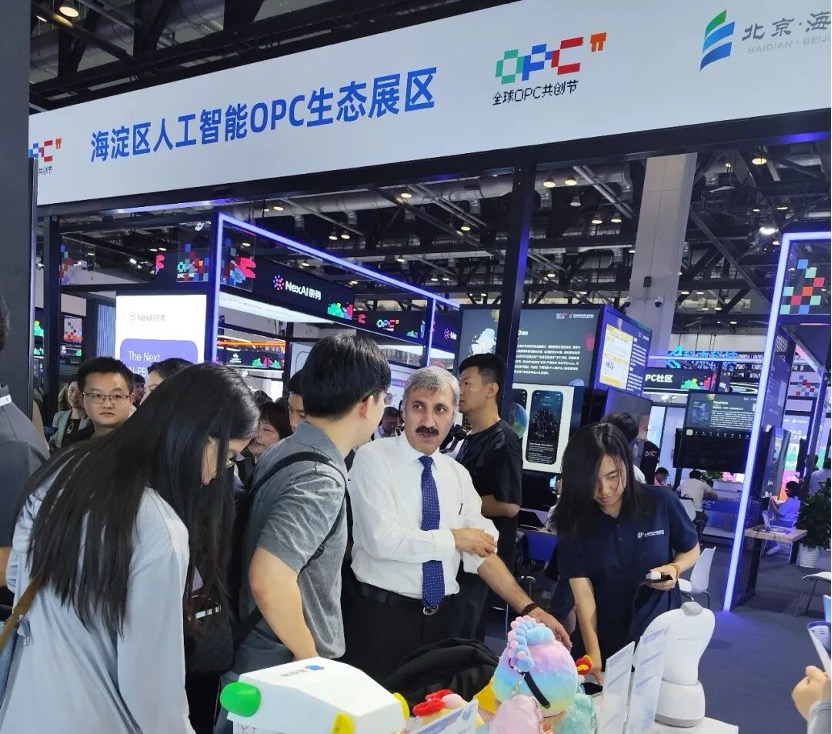
Haidian does not centrally design its communities. Instead, it follows a dual strategy of external import and internal incubation.
On one side, national AI communities such as SiliconFlow-style networks, SegmentFault, AGI Bar, and Datawhale are invited to establish permanent activity bases in Haidian. On the other, local ecosystems such as the “Token Plaza” inside AI North Latitude Community are cultivated as endogenous platforms.
The logic is deliberate: external communities inject national and global innovation flow, while internal communities ground experimentation in local industrial constraints. The result is a feedback loop of external inspiration, local validation, and rapid iteration.
Technical salons, hackathons, and open-mic sessions occur almost weekly across different venues. Participants often shift roles within a single day — student in the morning, startup presenter in the afternoon, audience member in the evening.
This high-frequency, low-barrier interaction transforms isolated individuals into real economic agents. Many OPCs secure their first client, co-founder, or funding introduction in these informal environments.
For single-person companies, isolation is often a greater constraint than technology. Community infrastructure functions simultaneously as emotional proximity and deal flow engine.
4. The “Five Parties, Six Forces” System: Hidden Coordination Infrastructure
Behind visible policies and communities lies a coordination mechanism known as “Five Parties, Six Forces.”
The “five parties” include Zhongguancun Science City, universities and research institutes, investment funds, incubators, and science parks. Rather than operating in sequence, they function as a synchronized consortium.
The “six forces” framework aligns them through functional roles: organizational force (governance rules), innovation force (supply generation), value force (industrial alignment), cultivation force (mentorship and resources), carrying force (infrastructure), and market force (real-world validation).
A case illustrates how this operates.
Meta Origin Intelligence, founded by a PhD candidate jointly trained at Beijing Zhongguancun Academy and Fudan University, built “Casepilot,” an AI-driven platform that matches enterprise project cases with suitable technical talent. The system addresses a persistent inefficiency: fragmented hiring and low matching accuracy in technical recruitment.
Within this framework, universities provide talent and academic support, funds engage at early stages, incubators provide acceleration and scenario access, and parks offer workspace and compute infrastructure. The result: a founder in his early twenties iterated the product within two months and moved toward commercialization.
Haidian is also advancing “education–science–talent integration” through this mechanism. Doctoral students from 31 partner universities are selected for practical AI training programs structured around “project-first, coursework-later” principles. Labs and incubators are physically integrated, with industry mentors embedded directly into research environments.
In this model, learning, research, and incubation collapse into a single process.
5. Ecosystem Output: From Isolated Cases to System-Level Capacity
An ecosystem’s effectiveness is measured not by policy volume but by the type of individuals it enables.
When experimentation costs fall and coordination friction declines, previously excluded builders begin to enter the system. A growing cluster of OPC-driven projects illustrates this shift.
Examples include:
- “Dragon Bone Animation,” an AI-driven 2D skeletal animation platform that converts natural language into animation, winning first prize in the OPC category at the 9th “Entrepreneurship Beijing” competition.
- OS industry teams leveraging Tsinghua operating system research to deploy domestically developed systems in educational robotics across top schools.
- AI-native consumer electronics startups entering sleep health and emotional companionship markets.
- AI Studios platforms generating digital humans and multilingual video content via text prompts, serving finance, retail, and media clients.
- Enterprise AI agent systems built by teams with backgrounds from major Chinese tech firms, deployed across digital transformation scenarios in state-owned and private enterprises.
The shared pattern is structural: extremely small teams generating disproportionately large economic output.
These ventures span consumer applications, enterprise systems, developer tools, and frontier research. All are embedded in Haidian’s policy, community, and coordination infrastructure.
At scale, Haidian hosts more than 2,000 AI companies, over seven trillion- or billion-scale leading firms, and nearly 40% of Beijing’s unicorns. Around 40% of China’s top AI researchers and nearly half of its rising academic talent clusters are also concentrated here.
Density reduces transaction costs — for capital, talent, and customers — and amplifies individual creativity through network effects.
6. Toward the Future: From Showcase to Co-Creation Platform
At the 2026 Global Digital Economy Conference, Haidian went beyond showcasing outcomes. It co-launched a “Global OPC Co-Creation Festival” and announced plans for an OPC Entrepreneurship Conference in the autumn.
The direction is clear: export the operating system, not just display it.
Haidian is actively inviting global super-individuals into an ongoing experiment, while continuing to refine institutional pathways that support international scaling.
The broader implication is structural. In the next phase of competition among cities, advantage will depend less on capital attraction and more on how deeply systems understand and serve individuals.
This is not a new idea, but AI makes it newly decisive. When a single person plus a toolset can shape entire industries, the “super-individual” is no longer an exception — it becomes the default unit of innovation.
Haidian is positioning itself accordingly.
The slogan at the exhibition entrance can thus be read differently:
“Come to Haidian” is not a relocation decision. It is entry into a continuously evolving system — where policy tracks your growth, space responds to your needs, communities absorb your isolation, and institutions remove friction from your path.
In such a system, the super-individual is no longer a headline. It becomes an ordinary day.
❓ Frequently Asked Questions
Q: What does the "Five Parties, Six Forces" system mean in Haidian's innovation ecosystem?
A: It is a synchronized coordination mechanism. The "Five Parties" (government, universities, funds, incubators, science parks) align through "Six Forces" (governance, supply, alignment, mentorship, infrastructure, market validation) to collapse the learning, research, and commercialization phases into a single, high-speed process for solo founders.
Q: How does Haidian address the isolation and compute costs faced by One-Person Companies?
A: Through structural policy and physical embedding. Haidian offers up to 2 million RMB in model vouchers to offset compute costs and anchors solo founders in specialized physical hubs (like AI North Latitude Community), turning abstract subsidies into tangible networks that eliminate emotional isolation and accelerate B2B deal flow.
🎓 Deepen Your Strategic Mastery
Are you ready to stop operating in isolation and start leveraging powerful ecosystem infrastructures? In the SOLOMOAT Mini MBAs, we decode the precise policy frameworks, community leveraging tactics, and structural business models required to thrive as a globally competitive AI Super-Individual.