The Hardware AI Boom: Hiring Trends in China's Smart Manufacturing and EV Sectors
Aug 05, 2026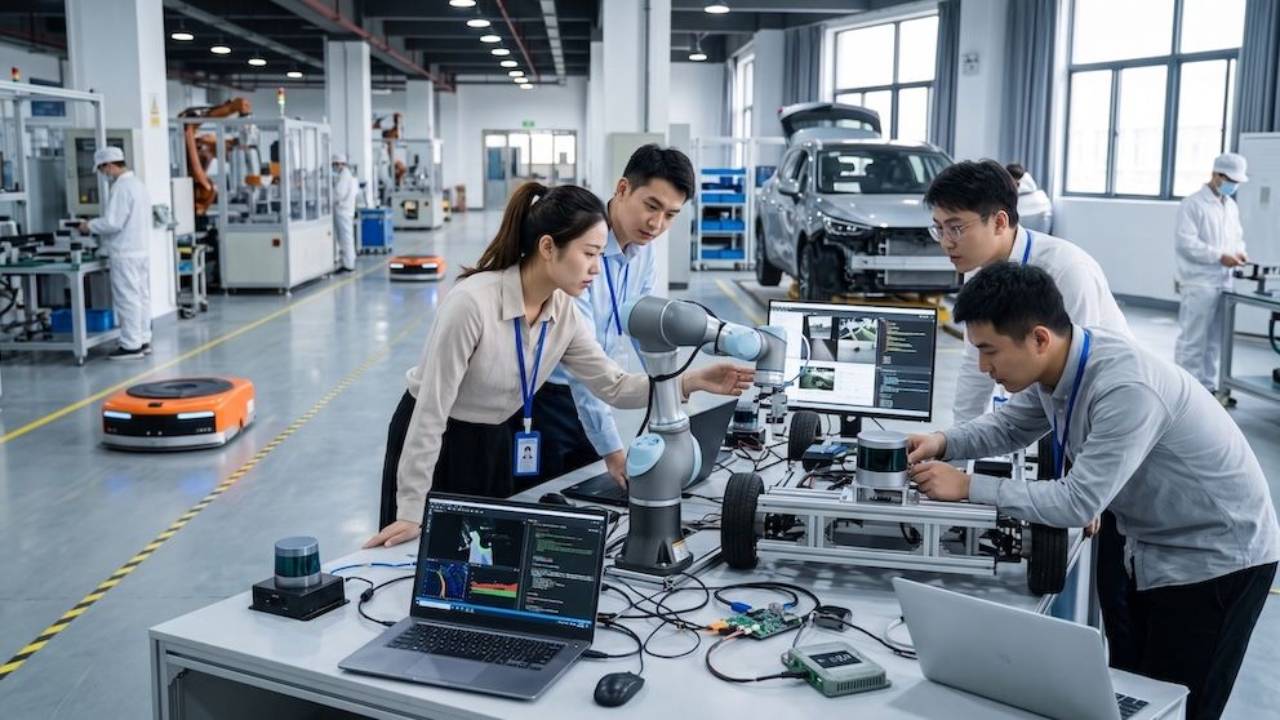
By Garbo Tian
💡 Core Strategic Takeaway
China's next AI hiring wave is increasingly physical: smart factories, robotics, autonomous mobility, and edge devices require professionals who can connect models with sensors, machines, and production systems.
When discussing Artificial Intelligence, the narrative often focuses entirely on software and chatbots. However, as NVIDIA CEO Jensen Huang noted at the World Economic Forum, AI is a "five-layer cake" encompassing energy, chips, infrastructure, models, and practical applications. In Mainland China, the physical application of AI—specifically in smart manufacturing and autonomous vehicles—is creating a massive hardware-oriented hiring boom.
The Industrial AI and Smart Factory Revolution
Supported by strong automation demand in logistics and manufacturing, China's robotics and embodied intelligence sectors are expanding rapidly.
Computer Vision Engineers: These professionals develop AI models deployed directly on factory production lines to detect defects, automate visual inspections, and improve overall quality control.
Robotics AI Engineers: Tasked with developing motion planning, perception, and navigation algorithms, these engineers enable industrial machinery and warehouse automation systems to interact autonomously with physical environments.
Industrial AI Architects: These architects design the end-to-end solutions that link operational technology (OT) systems with enterprise IT data platforms, ensuring scalable deployment across massive manufacturing environments.
The Autonomous Mobility Ecosystem
China remains one of the fastest-growing markets for intelligent vehicles, producing over 12 million EVs annually. This scale requires a deep bench of highly specialized automotive AI talent. EV manufacturers and Tier 1 suppliers are heavily recruiting Sensor Fusion Engineers to integrate multi-modal data from cameras, LiDAR, and radar. Furthermore, as vehicles rely increasingly on onboard computing rather than cloud processing, Edge AI Engineers are in high demand to optimize machine learning models for low-latency, embedded in-vehicle deployment.
2026 Salary Expectations: Manufacturing & Automotive
| Job Title | Industry Sector | Entry-to-Mid Level Salary (RMB) | Senior/Lead Salary (8+ yrs) (RMB) |
|---|---|---|---|
| Computer Vision Engineer | Automotive Manufacturing | 400K - 650K | 800K - 1.3M |
| Industrial AI Architect | Industrial Manufacturing | 600K - 900K | 1.1M - 1.7M |
| Robotics AI Engineer | Robotics Manufacturers | 450K - 700K | 900K - 1.4M |
| Autonomous Driving Alg. | Autonomous Driving Startups | 800K - 1.2M | 1.5M - 2.5M+ |
| Sensor Fusion Engineer | EV Manufacturers | 650K - 1.0M | 1.2M - 1.8M |
| Edge AI Engineer | Smart EV Manufacturers | 650K - 1.0M | 1.2M - 1.9M |
Overcoming Structural Bottlenecks
Integrating AI into hardware brings unique challenges. The sheer complexity of Data Integration across industrial and mobility ecosystems continues to slow model deployment. Industrial and mobility AI applications depend heavily on large datasets, but fragmented data infrastructure means that experienced data governance professionals and system architects will be highly sought after throughout 2026.
❓ Frequently Asked Questions
Q: What is driving China's hardware AI boom?
A: Rapid investment in smart manufacturing, robotics, electric vehicles, sensors, and edge computing is expanding demand for applied AI roles.
Q: Which roles are most important?
A: Computer vision engineers, robotics AI engineers, industrial AI architects, autonomous-driving specialists, and edge AI engineers are central roles.
Q: What limits hiring growth?
A: Organizations still face shortages of professionals who can combine model development with industrial systems, data integration, safety, and governance.
🎓 Build Your AI-Native One-Person Company
Explore SOLOMOAT Mini-MBA masterclasses for deeper frameworks on China, AI automation, business systems, and global growth.