How to Use AI Effectively: One Year of Leverage for a Decade of Growth
Jul 24, 2026
By Garbo Tian
Last year, when we talked about AI, the focus was “efficiency.” A three-hour report became a one-hour task; a ten-person workload could be handled by five. Efficiency still matters. But if you treat AI merely as a faster horse, you miss its real value. AI is closer to an airplane—something that takes you to places neither walking, riding a horse, nor driving could ever reach.
Today’s question is not how AI helps you save time. It is how AI reshapes decision-making, enables innovation, breaks deadlocks, and gives you capabilities that previously did not exist. We will walk through practical methods, real-world cases, and a central idea: AI is not a tool. It is a capability.
💡 Core Strategic Takeaway: From Efficiency to Capability
- The Efficiency Trap: Treating AI as a mere productivity shortcut misses its true function as an airplane that collapses the entire logic of distance and friction.
- The Context Imperative: AI knows all global knowledge, but it knows nothing of your corporate constraints unless explicitly fed your specific financial scale, margins, and market positioning.
1. How to Use AI Effectively
AI is undergoing a structural shift in modern business. In the past, companies mainly used AI to improve efficiency—automating data analysis, generating reports, and reducing manual workload. But as the technology matures, its value needs to be redefined.
From Efficiency to Capability
Most organizations still see AI as a productivity tool. That framing is correct—but incomplete. The next stage is not faster execution. It is capability expansion—doing things that were previously outside human reach. Think of transport: walking takes months, a horse takes a month, a car reduces it to a day, and flying collapses distance itself. AI operates as an airplane for cognition.
AI Requires Structured “Playbooks”
AI already contains near-total human knowledge. So why do many users feel it underperforms? Because the problem is not AI; it is how it is invoked. Without structured prompts, outputs are shallow. Using cognitive interfaces like PDCA, PEST, and SMART frameworks turns a general system into an active domain expert.
AI Needs Context & Multi-Round Dialogue
AI knows everything—except your company. Without context like your revenue scale or competitors, answers remain abstract. Furthermore, AI usage is not a one-shot query. Complex problems require multi-round refinement, and cross-model validation (running prompts across DeepSeek, Kimi, Doubao, Gemini, and others) produces sharper insights than any single output.
2. Case Demonstrations: Frameworks and Architectures
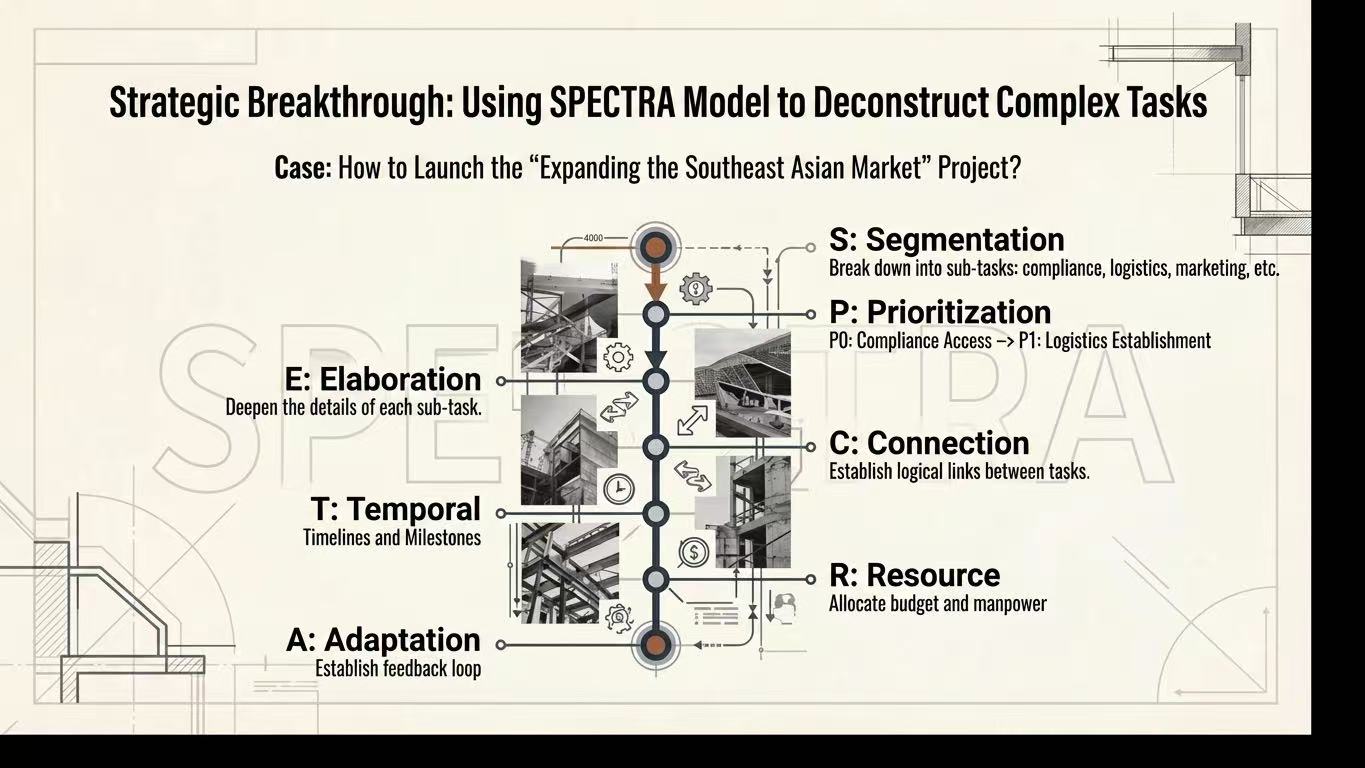
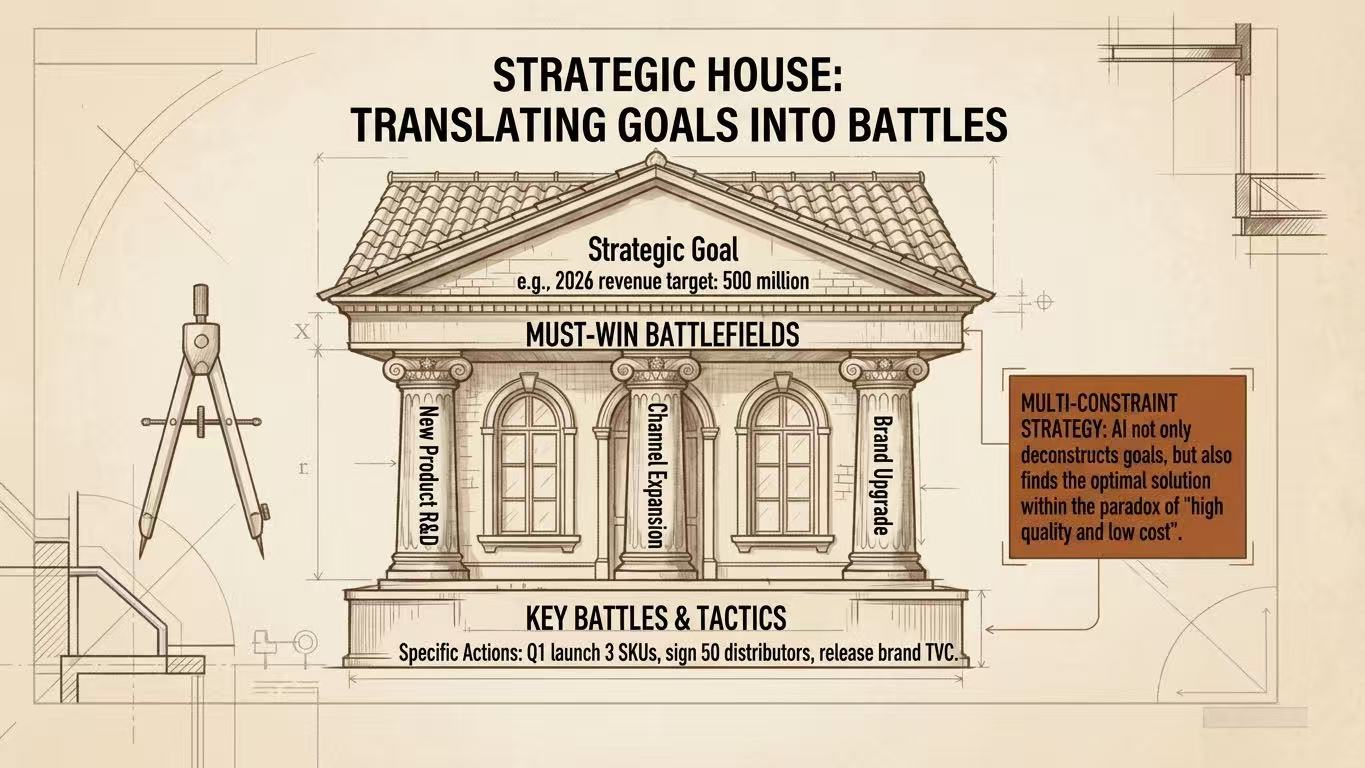
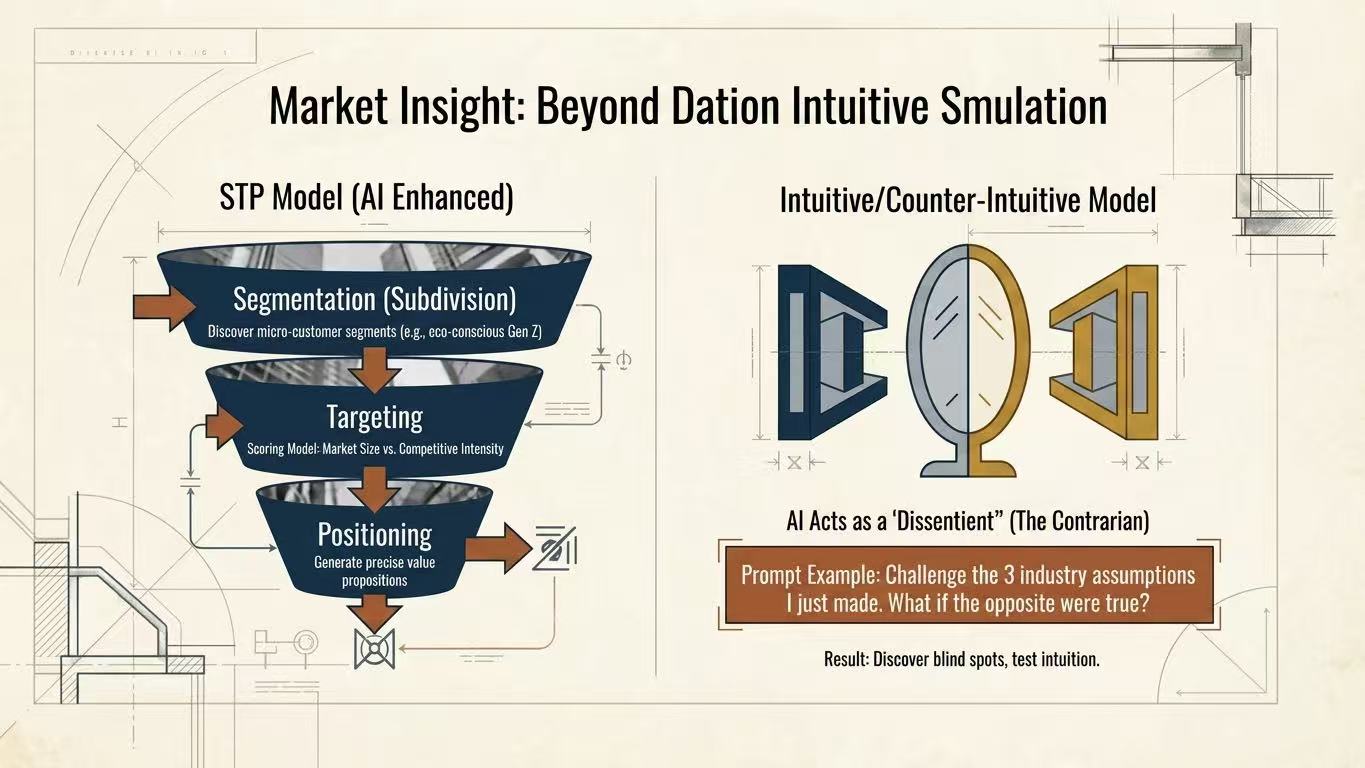
The following strategic matrix outlines how structured models and multi-dimensional frameworks supercharge machine reasoning:
| Strategic Framework | Core Functional Mechanism | AI Operational Application |
|---|---|---|
|
SPECTRA Model
|
Designed specifically for machine reasoning tasks by Tsinghua researchers. | Excels at complex problem decomposition (e.g., entering new regional markets). |
|
Strategy House
|
Breaks macro goals into layered structures (pillars, arenas, tactical actions). | Turns large revenue targets into manageable operational units. |
|
STP & Counter-Intuition
|
Segmentation, Targeting, Positioning combined with assumption stress-testing. | Challenges entrenched management assumptions to uncover hidden market opportunities. |
|
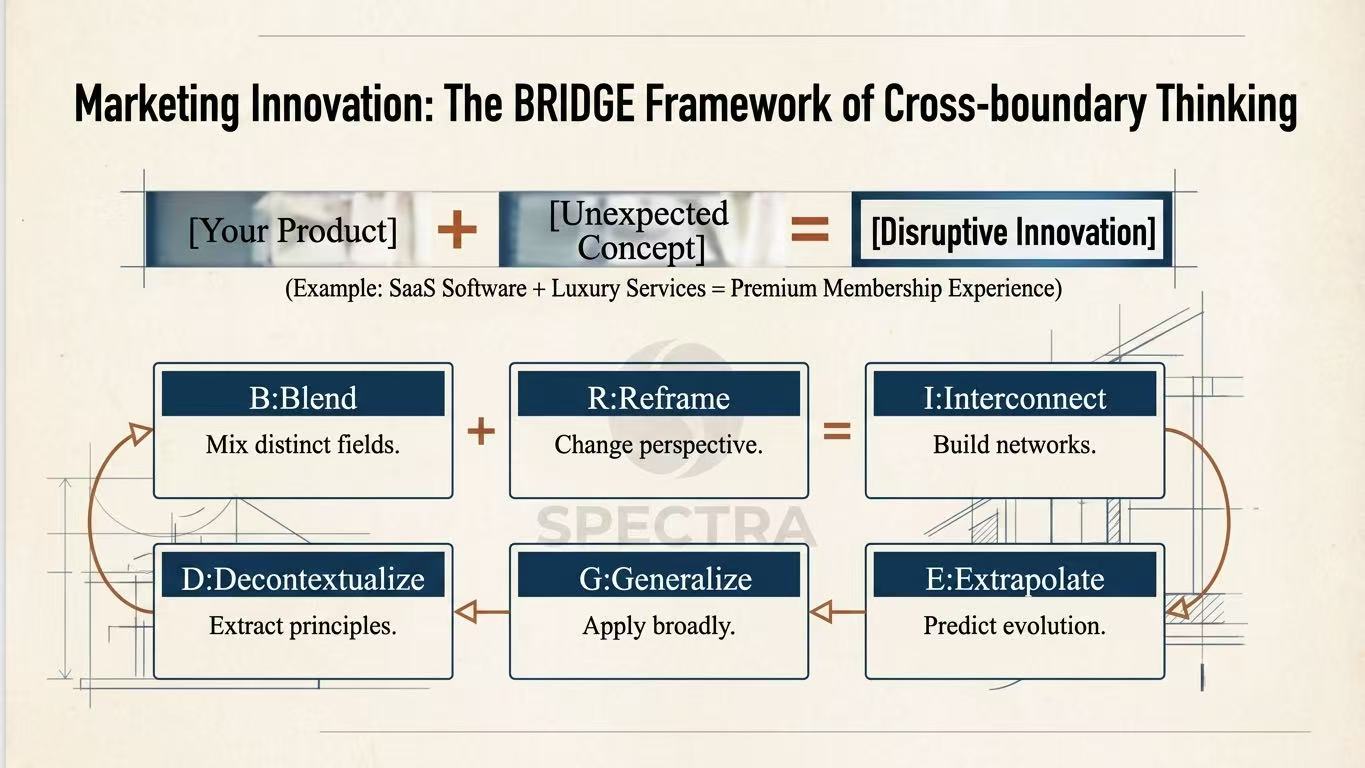
BRIDGE Framework
|
Cross-industry recombination and structural restructuring. | Frees innovation from cognitive inertia by borrowing operating logics externally. |
3. AI Is Not a Tool. It Is a Capability.
Future AI systems will evolve from “decision support” to decision execution.
AI agents will run workflows, simulate outcomes, and present complete operational plans. Humans will increasingly act as approvers rather than decision-makers.
For example, AI may recommend:
- avoiding direct entry into a market
- using intermediary distribution networks instead
- reallocating internal headcount based on productivity data
These are not abstract insights. They are executable strategies.
In such a system, AI does not assist decision-making—it produces decisions.
Humans remain responsible for approval, but not for constructing the full analytical chain.
AI will also become capable of granular organizational diagnostics—identifying inefficiencies at the level of specific individuals, workflows, or teams.
Instead of saying “the company is overstaffed,” it may identify exactly which six roles are redundant, backed by data.
At that point, management becomes less about interpretation and more about execution of machine-generated clarity.
Conclusion:
AI knows the entire body of human knowledge—but it does not know your company, your constraints, or your competitive reality.
Its output quality depends less on intelligence and more on the quality of your prompts, structure, and context.
The clearer your framework, the sharper its reasoning. The richer your background, the more actionable its output.
Once you learn to systematically invoke global knowledge through structured reasoning, you are no longer working alone—you are operating with a distributed cognitive system.
More importantly, AI is redefining decision-making itself.
For executives, this is not optional. The cognitive boundary of leadership now defines the growth boundary of the organization.
We are operating inside a system undergoing deep transformation across politics, economics, technology, and philosophy.
The real challenge is that our mental models, organizational structures, and operational tools are still rooted in a pre-AI era.
What is needed now is a higher-order operating system for understanding complexity.
This is the premise behind PPE (Philosophy, Politics, and Economics) training programs designed for the AI era—helping leaders understand global systems, technological shifts, and strategic evolution.
In the next era of enterprise leadership, the real competitive advantage will not come from tools—but from upgraded cognitive systems.
❓ Frequently Asked Questions
Q: Why is treating AI as an "efficiency tool" insufficient?
A: Efficiency treats AI like a faster horse, saving time on existing tasks. Treating AI as a capability or an airplane allows it to reshape decision-making, break deadlocks, and unlock possibilities that were previously outside human reach.
Q: How do structured frameworks like SPECTRA or BRIDGE improve AI output quality?
A: They act as cognitive interfaces. Providing explicit intellectual frameworks forces discipline into prompt engineering, ensuring that both human and machine operate within the same rigorous logical system rather than generating generic responses.
🎓 Deepen Your Strategic Mastery
Ready to upgrade your leadership operating system for the AI era? In the SOLOMOAT Mini MBAs, we decode the precise cognitive frameworks, AI toolchains, and strategic workflows you need to build a distributed cognitive system for your enterprise.