Why New Energy Giants are Resurrecting the High-Seas Fleets of the Age of Discovery
Jul 28, 2026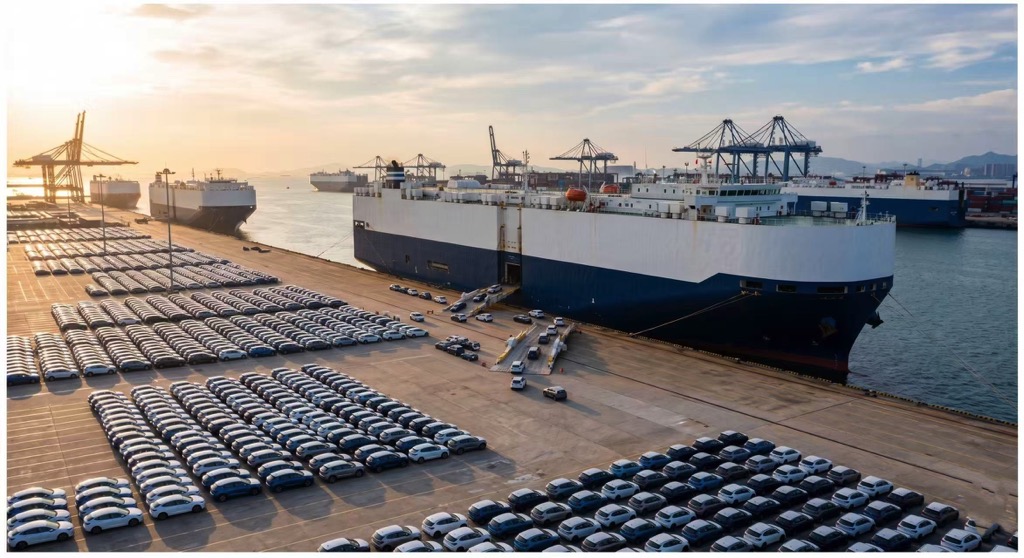
By Garbo Tian
Why do carmakers with global ambitions pour capital into proprietary RO-RO (roll-on/roll-off) fleets? This is no quest for lateral diversification; it is a bid to establish “logistics sovereignty.” Faced with the caprice of global shipping capacity and exorbitant maritime costs, internalizing ocean transport as a proprietary asset serves as a strategic risk-management tool to ensure the punctual and stable delivery of products in global markets.
What is the value of “Vertical Integration 2.0” amidst macro uncertainty? If the vertical integration of yesteryear was a lean management exercise focused on cost optimization, the 2.0 era is an exercise in ecosystem building predicated on “total factor security.” From taking equity stakes in upstream critical minerals to the self-development of core chips and the assembly of ocean fleets, enterprises are attempting to internalize uncontrollable geopolitical and market risks into internal certainties.
What does the shift from “Just-in-Time” to “Just-in-Case” signify for global supply chains? In an age of geopolitical friction and frequent macro “black swans,” hyper-minimalist supply chains chasing zero inventory have revealed a profound fragility. Conversely, firms possessing the deep moats of heavy assets and closed-loop industrial chains are better positioned to maintain stable gross margins amidst crisis.
💡 Core Strategic Takeaway: The Dawn of Logistics Sovereignty
- From Just-in-Time to Just-in-Case: The era of highly fragmented, hyper-minimalist supply chains is over. True resilience now requires converting external friction and unpredictability into internalized, heavy-asset security.
- Vertical Integration 2.0: Leading multinationals are no longer just optimizing costs; they are constructing closed-loop ecosystems—from upstream critical minerals to proprietary semiconductor divisions and wholly-owned ocean transport fleets.
Stand today on the pier of Shenzhen’s Xiaomo International Logistics Port, and you will witness a grand tableau: one redolent of the Age of Sail, yet infused with the tension of modern technology. A gargantuan RO-RO vessel, stretching 200 meters with thirteen decks, sits quietly at berth, prepared to ferry thousands of electric vehicles to the European continent. The master of this steel behemoth is no traditional international shipping oligarch, but an automaker: BYD. In the hallowed case studies of the world’s premier business schools, “asset-light operations” and the “outsourcing of non-core business” were once enshrined as the golden rules for maximizing capital returns. Why, then, in the 21st century, does a technology manufacturing firm behave like the East India Company of old, sparing no expense to assemble its own high-seas fleet? Once you grasp the intent behind this vessel, you realize that as the rules of globalization are being rewritten, the true multinational giants are reconfiguring the very foundations of their existence.
1. From Efficiency to Sovereignty: Reforming the Laws of Global Survival
For multinational executives, professionals, and private investors who have weathered the storms of Suez Canal blockages, chip shortages, and skyrocketing freight rates, BYD’s “Vertical Integration 2.0” is a masterclass in macro risk management with profound practical relevance.
For thirty years, global supply chains hummed under the banner of efficiency and the division of labor. Yet the macro-turbulence of recent years serves as a chilling reminder: excessively fragmented supply chains are perilously fragile in extreme environments. Whether it is the irrational volatility of critical ore prices or the supply cutoff of a minuscule electronic component, each is sufficient to paralyze a vast production line in an instant. Faced with such systemic vulnerability, this Eastern leviathan has offered a hard-core and resolute solution: since the friction costs of the external environment are unpredictable, one must establish “ecosystem sovereignty” through the dual extension of capital and technology. While Wall Street still hedges raw material risks via futures contracts, BYD’s engineers have already ventured deep into mining districts to lock in upstream resources. While peers slash production due to chip scarcities, its proprietary semiconductor division provides a continuous stream of foundational support. The maiden voyage of giant RO-RO ships completes a critical piece of this "anti-fragile" macro puzzle. In a tomorrow where uncertainty is the new normal, “sovereignty certainty” is becoming a more precious business asset than “marginal efficiency”.
2. Strategic Alpha: The Cross-Industry Disruption Matrix
| The Risk (Legacy Vulnerability) | The Strategic Play (Systemic Shift) | The Alpha (Structural Dividend) |
|---|---|---|
| Delivery loss of control from the fetish of "extreme outsourcing": By relying entirely on third parties for core components and cross-border logistics, firms become passive and vulnerable to "broken links" during geopolitical crises or capacity shortages. | Establishing "logistics and delivery sovereignty" at critical nodes: Breaking capacity bottlenecks and price blockades through strategic investments or the acquisition of ocean transport assets to ensure the trade arteries remain unobstructed. | Drastically cutting uncontrollable external friction costs; securing transnational cash flow and the efficient flow of product delivery. |
| Passive endurance of upstream raw material cycles: In high-growth sectors like new energy, the profits of vehicle or terminal manufacturers are easily cannibalized by skyrocketing resource costs. | Upstream penetration to build a "resource reservoir": Extending capital reach to the source of critical raw materials through equity stakes or deep bindings to achieve a smooth transition from extraction to manufacturing. | Smoothing the violent fluctuations of commodity cycles; maintaining healthy margins even when the entire industry is under cost pressure. |
| Supply crises of "minor components" in global labor division: A lack of self-development capabilities for core chips and other critical electronic components leaves the lifeline of the firm subject to a few oligarchs. | Creating an internal loop for "foundational hardware": Establishing a self-developed and self-produced system spanning from power semiconductors to core control units to ensure the security of the "core brain". | Enhancing systemic immunity to geopolitical friction and black-swan events; achieving true technological autonomy and production composure. |
Closing Thought
To build an immortal commercial moat in this new cycle of rewritten rules, we must transcend the antiquated supply chain models built on assumptions of absolute stability. Garbo Decodes China has profoundly dissected how Eastern enterprises demonstrate formidable ecosystem-building capabilities when confronting complex systemic challenges. As a high-level intellectual partner of the SOLOMOAT, our Mini MBAs global risk-management simulations will teach you to view the world from the perspective of a macro-navigator, transforming external turbulence into the sturdiest internal armor for your enterprise, ensuring your commercial fleet sails steadily through the waves of the era.
❓ Frequently Asked Questions
Q: Why are modern technology and energy firms abandoning "asset-light" operations in logistics?
A: In an era of macro uncertainty, extreme outsourcing leads to vulnerability. Firms are acquiring heavy assets like RO-RO vessels to establish "logistics sovereignty," ensuring that supply chain blockades or skyrocketing freight rates do not paralyze their global delivery capabilities.
Q: What is Vertical Integration 2.0?
A: Unlike traditional integration focused merely on cost efficiency, Vertical Integration 2.0 focuses on "total factor security." It involves taking ownership across the entire ecosystem—from mining raw minerals to proprietary chip development and self-owned ocean transport—to convert external unpredictability into internal certainty.
🎓 Deepen Your Strategic Mastery
Are you still clinging to the fragile assumptions of a hyper-minimalist supply chain? In the SOLOMOAT Mini MBAs, we decode the precise ecosystem-building frameworks, macro risk-management tactics, and Vertical Integration 2.0 strategies required to build an immortal commercial moat in turbulent times.