Future Perspective | The Rise of the “Super Individual”: The Emergence of One Person Companies (OPCs) and the Reconfiguration of Production
Jul 30, 2026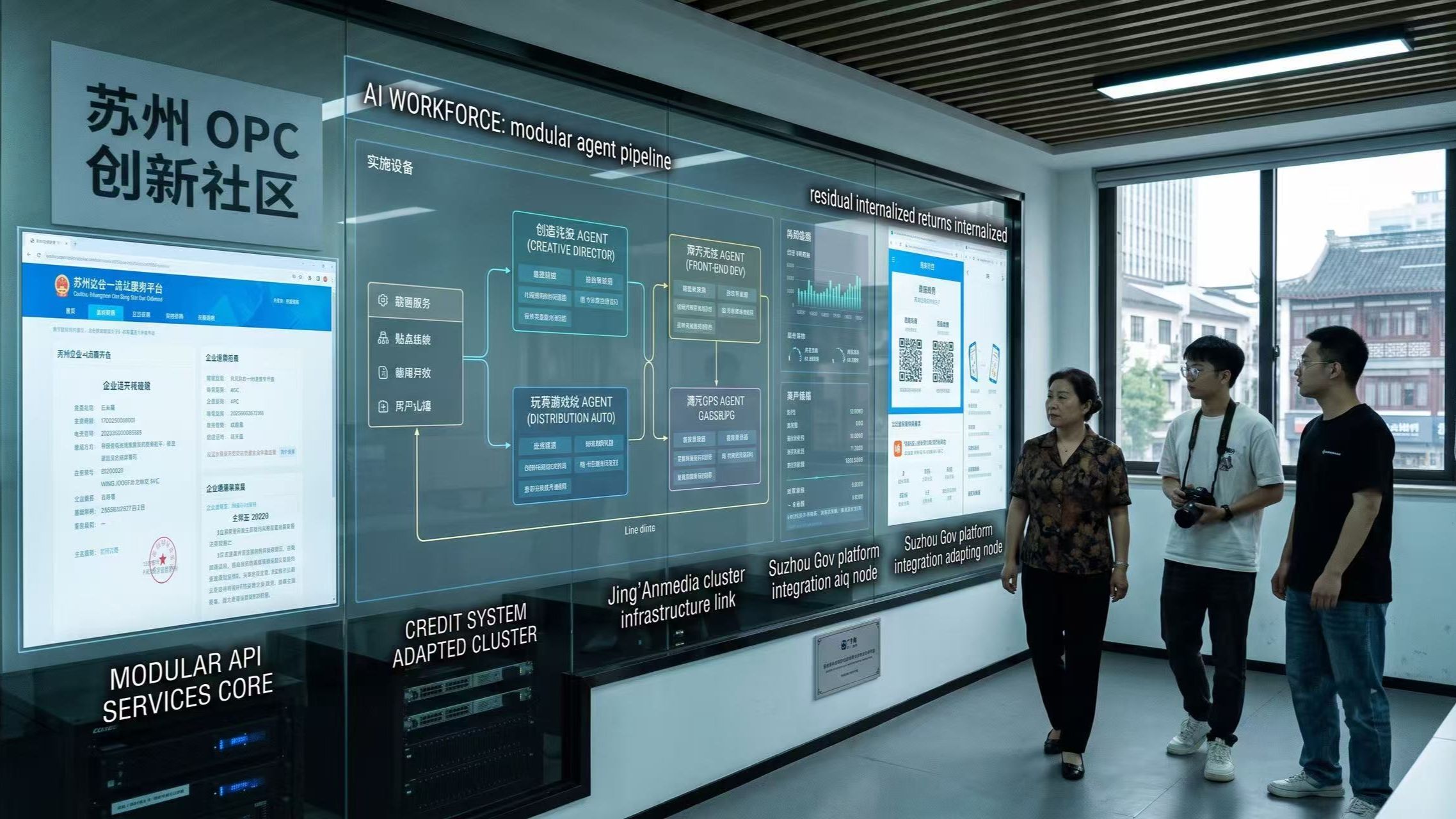
By Zhou Junyan
As platform economies mature and AI agent technologies enter mainstream deployment, the foundational logic of business is shifting.
The minimum viable unit of entrepreneurship is contracting from teams to individuals. Value creation is migrating from physical organizations to digital systems. Within this restructuring of production, the One Person Company (OPC) has emerged as a new organizational form.
Legally, an OPC refers to a sole proprietorship structure. Functionally, it has evolved into a technology-enabled production paradigm: “one individual plus AI equals a company.” In this model, a single entrepreneur, working in close coordination with AI systems, can complete the full commercial loop—from product design and development to distribution, operations, and customer service.
In early 2024, OpenAI CEO Sam Altman suggested that AI would eventually enable “one-person unicorns” valued at over $1 billion.
💡 Core Strategic Takeaway: The Reconfiguration of Production
- The Collapse of Firm Boundaries: As AI APIs and digital platforms drastically reduce external transaction costs, the economic rationale for large, hierarchical organizations is giving way to the extreme agility of the individual.
- Economies of Unscale: Competition is no longer defined strictly by size and capital-intensive cost optimization, but by the ability of specialized human capital to leverage AI toolchains to operate at industrial intensity.
The Structural Logic Behind OPC Expansion
The rapid rise of OPCs is not a stylistic shift in entrepreneurship. It is an organizational transformation driven by the interaction of technological leverage, institutional evolution, and changing individual incentives.
From an analytical perspective, OPC expansion can be understood across three layers:
- a paradigm shift from scale-based economics to non-scale economics
- a reduction in transaction costs under digital infrastructure
- an internal reconfiguration of incentives and property rights within human capital
1. Paradigm Shift: From Economies of Scale to Economies of Unscale
In the industrial era, economies of scale defined corporate advantage. Expanding production reduced unit costs by spreading fixed costs over larger output, reinforcing the dominance of large integrated firms.
Cloud computing, AI systems, and digital platforms have altered this equation. Many fixed costs—compute, software, distribution—have been converted into on-demand variable costs. The link between firm size and cost advantage has weakened.
Smaller actors can now rent platform capabilities and concentrate on niche markets, competing directly with incumbents. As venture capitalist Hemant Taneja has noted, digital technology is dismantling traditional economies of scale.
A new logic—often described as “economies of unscale”—has emerged. Competition is no longer defined primarily by size and cost, but by agility and specialization. This shift creates structural space for atomic organizational units such as OPCs.
2. External Conditions: Falling Transaction Costs and Institutional Adjustment
The question of firm boundaries can be traced to Ronald Coase’s theory in The Nature of the Firm. Firms exist to reduce transaction costs. Their optimal scale is determined by the marginal trade-off between internal coordination costs and external market transaction costs.
When external transaction costs fall below internal management costs, organizational expansion becomes inefficient. Contraction becomes rational.
AI and digital infrastructure are the primary drivers of this shift. APIs have modularized global capabilities into callable services. For individuals equipped with AI toolchains, external markets increasingly resemble internal teams in terms of accessibility and execution speed.
Search, negotiation, contracting, and monitoring costs have declined sharply. In many domains, external coordination now outperforms internal hierarchy. Outsourcing becomes more efficient than employment.
This technological shift requires institutional alignment. Financial infrastructure such as digital payments, credit systems, and intellectual property protections reduces trust friction in remote transactions.
Legal frameworks have also adapted. China’s revised Company Law (2023) removed restrictions on the number of one-person limited liability companies and allowed the establishment of one-person joint-stock companies, significantly lowering compliance barriers for OPC formation.
The co-evolution of technology and institutions has enabled OPCs to move from theoretical construct to operational reality.
3. Internal Choice: Human Capital, Incentives, and the Organizational Optimum
As firm boundaries shrink, a more fundamental question emerges: why do individuals push this logic to its extreme and choose to operate alone?
Organizational economics argues that firms exist to mitigate principal–agent problems through incentive design and property rights allocation.
In the knowledge economy, the key productive asset is specialized human capital—expertise, skills, and creativity. Traditional employment contracts often fail to properly value or incentivize these intangible assets, leading to inefficiency and misalignment.
The OPC structure resolves this by collapsing the roles of owner, operator, and labor into a single entity. Incentives are fully internalized. Residual control rights and residual claims remain entirely with the creator of value, achieving an efficient allocation of human capital returns.
The structure also improves decision velocity under uncertainty.
This economic rationale aligns with a broader shift in individual work values. Technological equality has reinforced the appeal of “working for oneself,” while preferences for autonomy, flexibility, and work–life integration have strengthened.
As Paul Jarvis writes in Company of One, the objective of entrepreneurship need not be scale expansion, but sustainability and autonomy.
For holders of specialized human capital, OPCs represent a configuration that is both economically efficient and value-consistent.
Concentration of OPC Activity Across Sectors
OPCs tend to cluster in sectors where individual-AI collaboration offers maximum comparative advantage, primarily:
- digital content production
- AI-enabled services
- niche software and tool development
- cross-border digital commerce
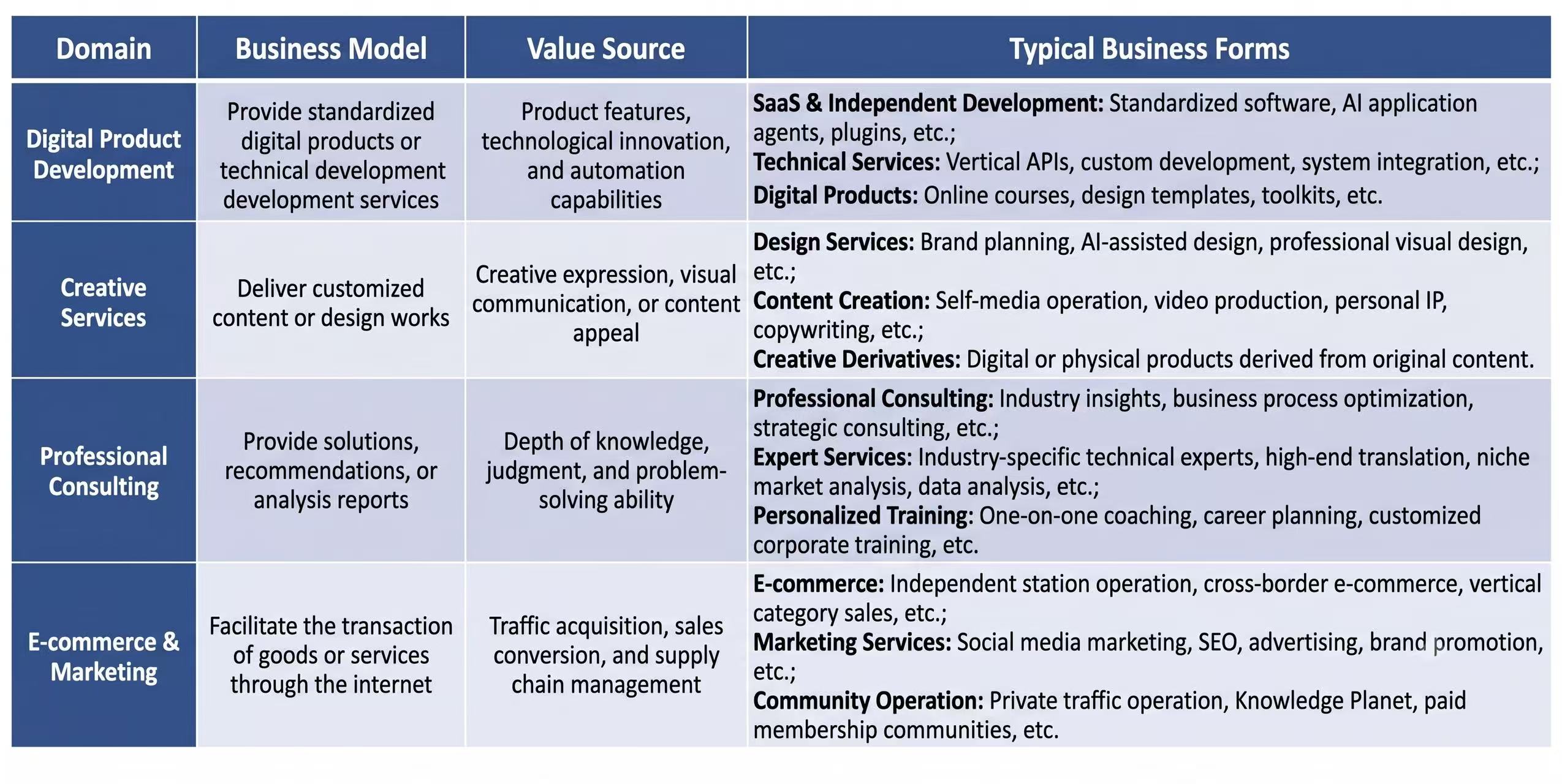
Across these domains, OPCs share four structural traits: lightweight asset structures, high cognitive input, creativity-driven value creation, and fully digital delivery systems.
OPC and Large Firms: An Ecosystem Relationship
OPCs do not operate in isolation. Their position is defined through continuous interaction with large firms.
OPCs offer agility, specialization, and rapid iteration. Large corporations provide scale, capital, infrastructure, and distribution systems.
This relationship is not zero-sum. Large firms increasingly absorb OPCs as innovation nodes, using them as early signal detectors and flexible production units. OPCs, in turn, rely on corporate platforms for resources, credibility, and market access.
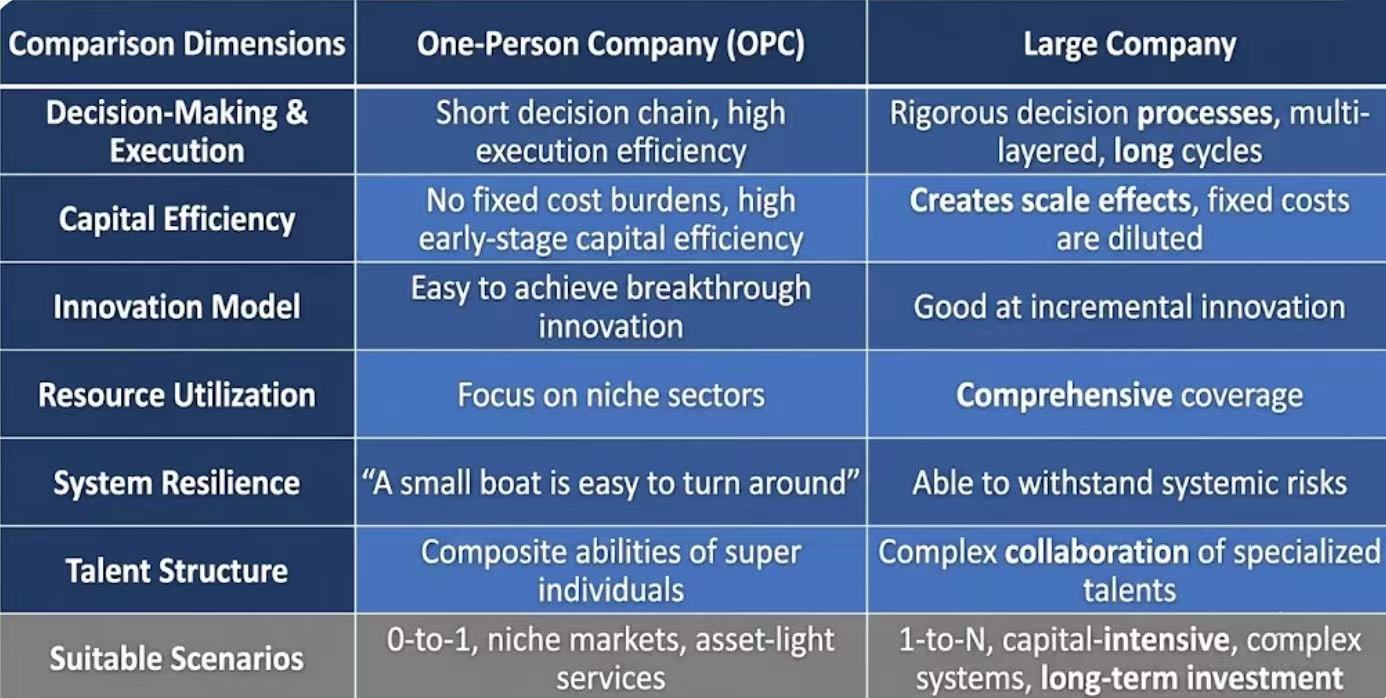
A hybrid innovation system is forming, reshaping value distribution across industries.
Structural Constraints
Despite their efficiency, OPCs face systemic vulnerabilities.
| Constraint Category | Systemic Vulnerability |
|---|---|
| Credit constraints | Lack of collateral reduces access to bank financing and increases counterparty risk. |
| Governance limitations | Single-person decision-making increases cognitive overload and reduces error correction capacity. |
| Coordination dependency | OPCs rely heavily on external networks and AI platforms, creating supply instability and technological lock-in risks. |
| Institutional lag | Regulatory systems remain designed for employment-based organizations, leading to gaps in taxation, social security, and compliance mechanisms. |
Early Signals from Chinese Cities
Cities such as Suzhou, Beijing, and Shanghai have begun experimenting with institutional frameworks to support OPC development.
| City / Region | Institutional Innovation & Ecosystem Strategy |
|---|---|
| Suzhou: Full-Chain Infrastructure Design | Suzhou has positioned itself as an OPC-first city, building integrated infrastructure covering compute resources, data access, policy services, and financing channels. Its strategy includes targeted industry applications, public competitions, and large-scale subsidy programs. By 2028, the city aims to incubate 1,000 OPCs and attract over 10,000 individuals. |
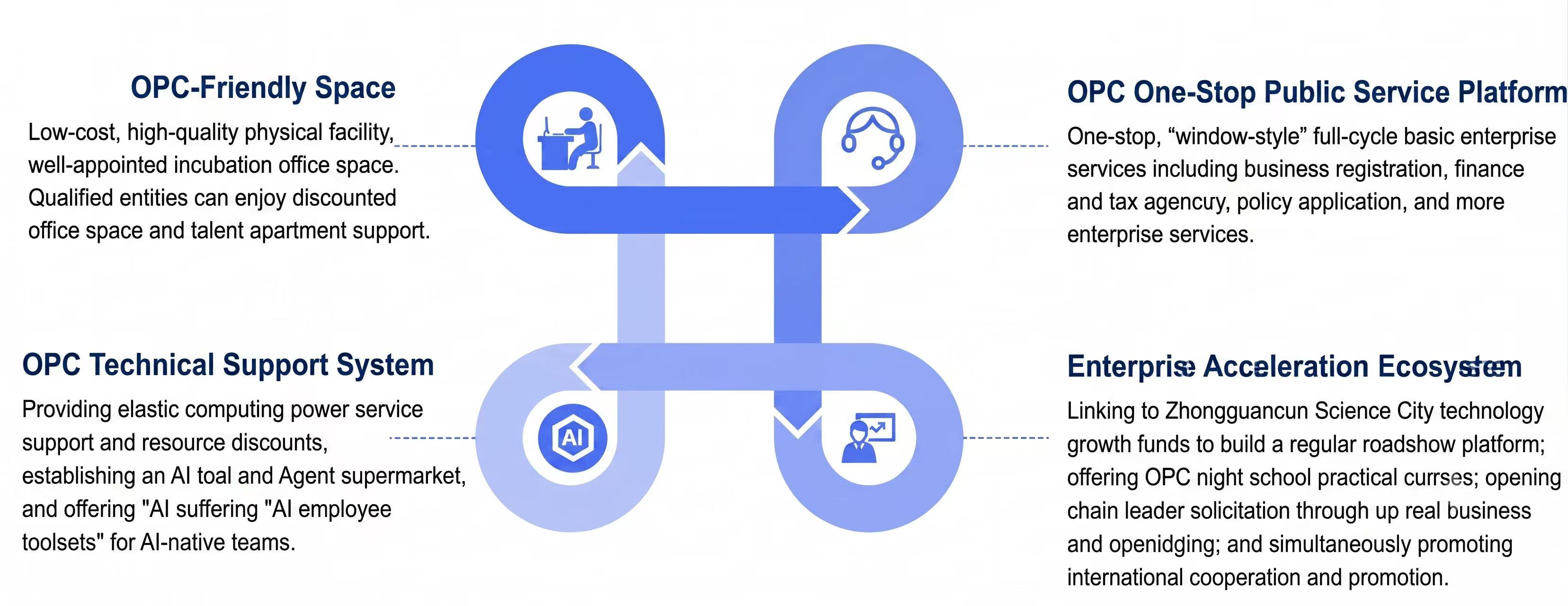
| Beijing: Platform-Based Ecosystem Acceleration |
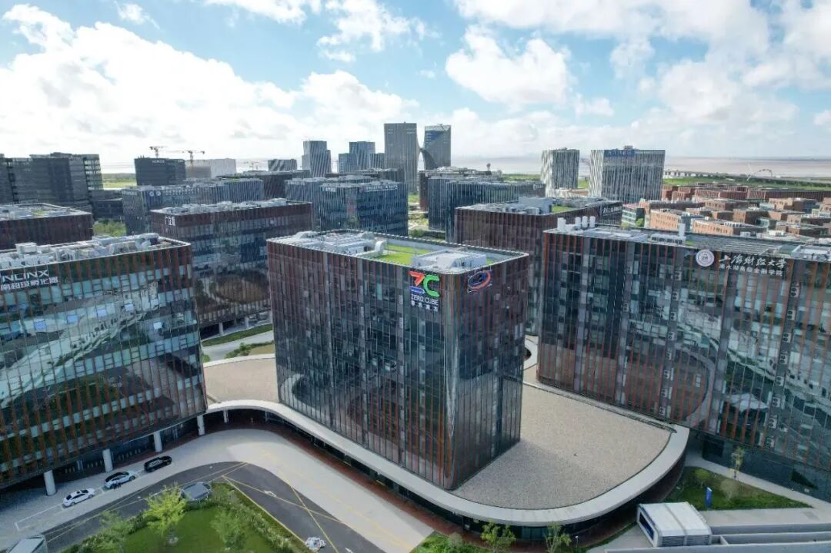
Beijing leverages its dense talent pool and research ecosystem, particularly through the Zhongguancun AI Beijiwei Community. Its model integrates universities, research institutions, and startup ecosystems into a unified pipeline from talent formation to commercialization. A structured support system combines physical space, compute access, and capital linkage across multiple stages of startup development.
|
| Shanghai: Institutional Innovation and Regional Differentiation | Shanghai reduces OPC operational costs through administrative reforms such as one-stop business registration and multi-license address policies. It simultaneously develops differentiated regional clusters: • Lingang focuses on cross-border and export-oriented OPCs, supported by free-trade policies and data mobility reforms.
• Xuhui builds AI-native entrepreneurial communities integrating tools, scenarios, and capital access.
• Jing’an concentrates on AI-enabled audiovisual production under its high-end media cluster infrastructure.
|


Policy Implications: Four Structural Shifts
The evolution of OPC ecosystems suggests four directional changes in urban strategy:
- 1. Infrastructure redefinition: from physical infrastructure to digital production factors
- 2. Talent policy reorientation: from specialization to AI-augmented hybrid capability
- 3. Institutional flexibility: from rigid regulation to adaptive risk buffering systems
- 4. City–enterprise interaction: from policy attraction to co-evolutionary ecosystem design
OPCs represent more than a new business form. They signal a reconfiguration of production itself, where individuals—augmented by AI—become self-contained economic units.
Cities that succeed in this transition will not be those that simply subsidize startups, but those that rebuild the infrastructure of individual-scale production.
The next phase of competition is not between firms. It is between systems that can sustain millions of “super individuals” operating at industrial intensity.
❓ Frequently Asked Questions
Q: What does the term "Economies of Unscale" mean for OPCs?
A: It refers to the shift where extreme scale and heavy capital are no longer required to compete. Thanks to API modularity and AI toolchains, a single individual (an OPC) can rent enterprise-grade infrastructure on demand, allowing extreme agility and specialization to outmaneuver the sluggishness of large industrial firms.
Q: How does Coase's theory of transaction costs explain the rise of the One-Person Company?
A: Ronald Coase argued that firms expand until the cost of organizing an extra transaction internally equals the cost of carrying it out externally in the open market. AI and digital platforms have driven external transaction costs (search, negotiation, coordination) so low that hiring full-time employees is often less efficient than a single founder orchestrating external agents and APIs.
🎓 Deepen Your Strategic Mastery
Are you ready to grasp the macroeconomic shifts driving the OPC revolution and position yourself ahead of the curve? In the SOLOMOAT Mini MBAs, we decode the precise economic theories, AI agent toolchains, and structural business models required to thrive as a globally competitive Super-Individual.