The Rise of the One-Person Company: What It Does and How It Operates
Jul 27, 2026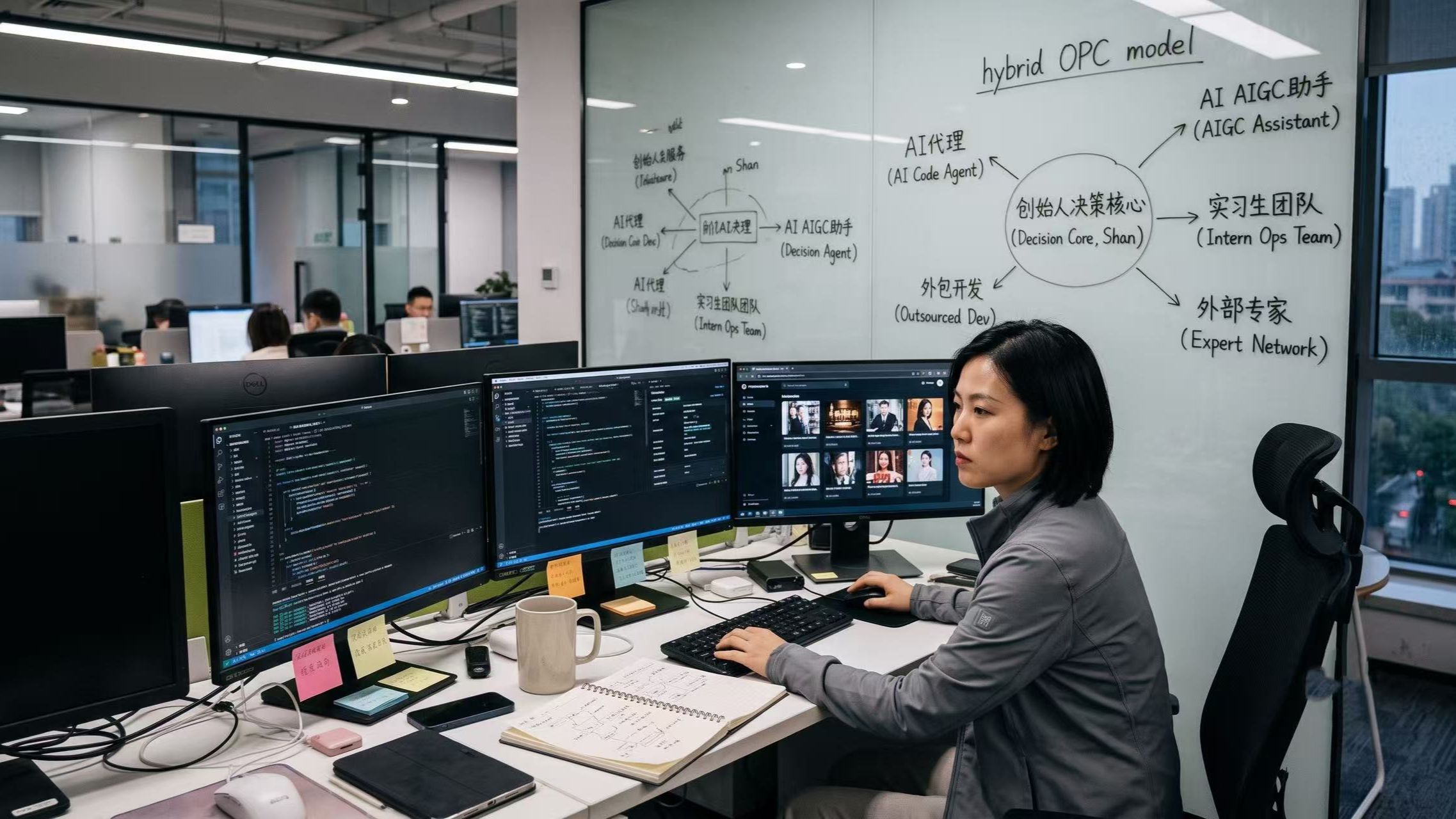
By Garbo Tian
As OPCs gain traction in early 2026, a new startup archetype is taking shape under the pressure of AI-driven automation.
💡 Core Strategic Takeaway: The Reconfiguration of Production
- Digital Labor as Infrastructure: An OPC is rarely a solo act; it is a decision core surrounded by a vast, invisible layer of AI agents and modular human collaborators.
- The Collapse of Entry Barriers: From deep tech to biotech and content generation, entrepreneurship is transitioning from a capital-heavy institutional event to a low-friction, continuously accessible operating state.
What is a “One-Person Company”?
The “One-Person Company” (OPC) has emerged as a new entrepreneurial format in the AI era.
Despite the name, it is rarely a literal one-person operation. Instead, it is typically structured around a single core decision-maker who operates a hybrid system composed of AI agents, a small number of human collaborators, and outsourced contributors.
In this model, “full-time employees” are surrounded by an invisible layer of “digital labor.” Product design, coding, marketing, and even contract drafting are increasingly handled by AI systems.
Industry observers note that the early wave of OPC founders tends to come from three groups: technologists with deep technical expertise, senior executives from large technology firms, and scientists with commercially promising projects. However, as AI tools become easier to access, participation is expanding beyond elite profiles to ordinary users.
For developers of smart hardware, core engineering tasks such as software, hardware integration, and algorithm optimization can be handled directly, while AI manages market research and content production. For AIGC creators, large models are used as creative infrastructure—generating scripts, ideation inputs, and IP concepts.
Compared with traditional firms, OPCs compress decision cycles, reduce fixed costs, and allow rapid pivots. These structural advantages align closely with the lightweight startup model enabled by AI infrastructure.
What are OPC founders actually building?
As OPC gains visibility, a growing number of founders are documenting their operating models.
AI-driven employment platform
He Shanshan, founder of Jiangsu Wutong AI, built a student-focused employment platform based on a proprietary job-matching model. The system provides job matching, CV optimization, and AI-based interview simulations. By the second half of last year, the platform reached roughly 90,000 daily visits, nearly double the level of the previous half-year. Her core team consists of only one full-time operator; all other functions are handled through a flexible network of technical partners, freelancers, and interns.
AI study-abroad matching system
Li Tao, CEO of Beijing-based Jian Education Technology, used AI tools to aggregate overseas university data and built a study-abroad selection product within two months. Users input academic scores, majors, and destination preferences. The system outputs five recommended universities. The product is available as both a website and a mini-program.
AI for industrial applications
Wei Bo, founder of Beijing Jile Space Technology, applies AI to industrial use cases such as construction safety monitoring and geospatial analysis of soil erosion and geological subsidence. The company follows a demand-first model: identifying industrial needs, then designing AI systems for operational upgrade.
AI in biotech R&D
PhD candidate Zhuang Kai is rebuilding the biotech R&D workflow using AI. In industrial enzyme development, for example, AI is used to search and design protein candidates with desired properties, narrowing the experimental search space. At early stage, his “company” consisted of a single operator supported by three AI agents acting as frontend engineer, algorithm researcher, and system engineer, forming an automated wet–dry lab workflow.
AI short-drama and virtual production
After two failed startups, entrepreneur Shi entered the AI-driven short-drama space. His early product is already in internal testing for professional production teams. The roadmap includes AI-generated actors, virtual IP operations, and hybrid real-human content systems. Within weeks of launch, the product secured a contract worth over RMB 1 million, and early users have already spent over RMB 100,000.
From professionals to students: the collapse of technical entry barriers
Beyond experienced founders, students and non-technical graduates are increasingly building OPCs. Li Tao (who has long followed AI development) co-founded a platform that can “generate AI applications using AI.” One student user, despite lacking programming skills, built an English vocabulary tool within a week. The product was positioned as: “the price of a cup of coffee (RMB 9.9) to memorize 100 words,” and quickly gained traction among peers, generating early revenue.
Grassroots builders and AI-native creation
In Nanjing, post-95 developer Li Xupeng uses AI platforms to generate mini-programs, creative apps, and small games, which are then distributed through social media and open-source communities. One of his AI-generated drama platforms compresses scriptwriting, storyboarding, voice generation, and subtitles into a single automated pipeline, producing content in 3–5 minutes and attracting nearly 10,000 users. A “gesture dance” mini-game he developed was later acquired by a large wedding services company for interactive use cases. He also provides AI training services to enterprises. As he puts it: “I don’t know programming. But AI does.”
Policy support across regions
Across China, local governments in Jiangsu, Beijing, Shanghai, Zhejiang, and Guangdong–Shenzhen are rolling out policies targeting OPC-style entrepreneurship.
Beijing
The Zhongguancun AI Beiwei Community launched an “AI OPC Service Program” in December 2025, aiming to build an OPC-friendly ecosystem. Services include office space, early-stage incubation, business registration, tax support, policy applications, investor roadshows, and expert lectures on technology and industry trends.
Jiangsu and Nanjing
Jiangsu’s provincial “AI+ initiative” explicitly supports OPC entrepreneurship. Local governments provide rent subsidies, talent incentives, and financing support for OPC founders.
Suzhou Industrial Park
A policy issued in November 2025 offers startup funding of at least RMB 50,000 for eligible university students and up to RMB 1 million for high-quality projects.
Shanghai
Shanghai has built four major startup clusters across Xuhui, Jing’an, Lingang, and Pudong. In Jing’an’s OPC innovation community, founders receive office space, up to RMB 100,000 in startup support, IP commercialization funding up to RMB 1 million, and staged competition rewards. Shared infrastructure includes AI model platforms, compute resources, and public demo facilities.
Shenzhen
Shenzhen has launched an OPC entrepreneurship ecosystem plan, using subsidies such as training vouchers, model vouchers, and data vouchers to reduce costs. It also provides tiered physical infrastructure—from desks to apartments—to support founders’ living and working needs. Multiple OPC communities are being built across Nanshan, Guangming, Luohu, Longgang, and Longhua districts.
Inside OPC communities: modular collaboration
Within these communities, OPCs can outsource tasks to each other. An AI hardware startup can delegate e-commerce sales to a neighbor company. Advertising work can be outsourced to content-IP creators in the same ecosystem. A fragmented startup stack begins to behave like a loosely coupled industrial network.
The sustainability question
Despite rapid growth, OPCs face structural uncertainty. A large number of AI products are already disappearing from the market. In a dataset of 5,136 AI tools, 1,481 have been shut down, acquired, or discontinued, with writing tools representing the highest share. Investors note that product cycles are collapsing. Many AI applications fail not because of technology, but because they never find stable use cases.
| Category | Key Observations & Pressures | Ecosystem Responses |
|---|---|---|
| Structural constraints of OPCs |
|
Some startup communities now provide legal and administrative support to address these gaps. However, as some founders note, OPC is only the starting point. Scaling requires introducing structured human collaboration, managing regulatory thresholds, and building organizational depth beyond a single operator. |
| Risk of overheating |
|
Observers warn of systemic risks. Policy researchers recommend shifting from blanket subsidies toward targeted ecosystem design—using project-based procurement mechanisms, shared compute infrastructure, and risk-sharing systems to stabilize early-stage innovation. |
Closing note
The OPC model lowers the threshold for entrepreneurship, but it does not eliminate structural constraints. What it does is compress the cost of experimentation. A single idea, a laptop, and access to AI systems are now sufficient to build a functioning company-like structure.
The result is not merely “one person replacing a team,” but a redefinition of what a company is: a decision core surrounded by AI execution and infrastructure-level coordination. Entrepreneurship, once reserved for capital-heavy organizations, is becoming a low-friction, continuously accessible operating state.
❓ Frequently Asked Questions
Q: What exactly defines a One-Person Company (OPC) in the AI era?
A: Despite the name, it is rarely a literal one-person operation. It is an organizational structure where a single core decision-maker operates a hybrid system composed of AI agents (handling coding, design, and marketing) alongside a flexible network of outsourced contributors, eliminating traditional fixed-cost employment.
Q: How are local governments supporting OPC startups?
A: Regions like Beijing, Shanghai, Shenzhen, and Jiangsu are building OPC-friendly ecosystems. Support includes rent subsidies, shared compute resources, AI model vouchers, and IP commercialization funding to lower the barrier to entry for solo founders.
🎓 Deepen Your Strategic Mastery
Are you ready to build a lightweight, high-margin business without the friction of a traditional team? In the SOLOMOAT Mini MBAs, we decode the precise AI toolchains, policy leveraging tactics, and modular collaboration frameworks required to operate a successful One-Person Company.