The Story Machine, AI Short Dramas, and the Algorithmization of Cultural Industry
Jul 31, 2026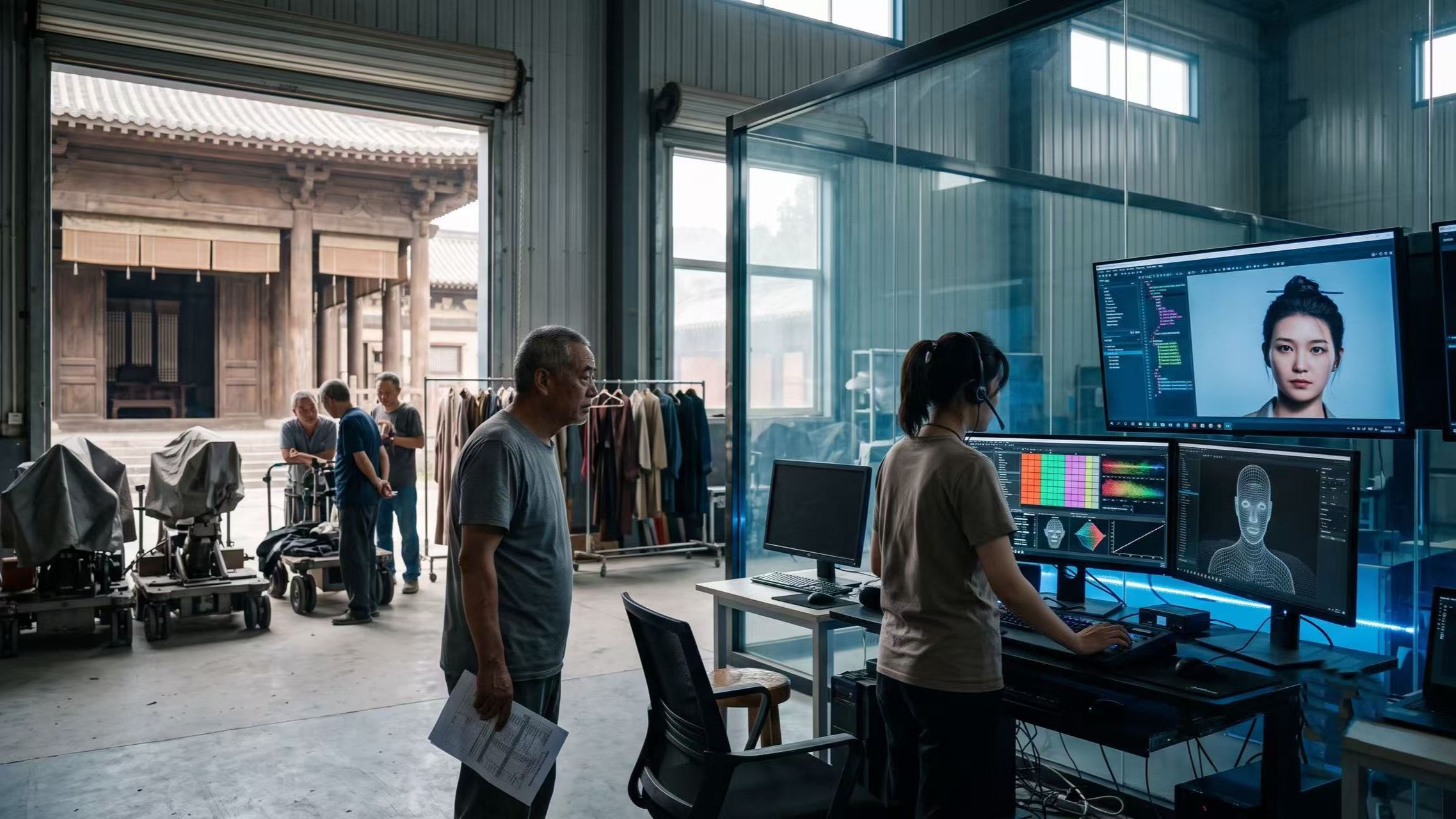
By Hu Yong (Peking University School of Journalism and Communication)
💡 Core Strategic Takeaway: The Software-ization of Culture
- The Collapse of Traditional Production: AI is not merely a tool for filming; it is restructuring cultural output into a software-like pipeline where text, production, and even human performance are converted into generatable algorithmic parameters.
- The Attention Shift: The transition from live-action long video to AI-generated short dramas reflects a deeper cognitive shift from deep cultivation to attention harvesting, fundamentally redefining human perceptual depth.
How Short Dramas Mutate Twice
Short dramas are a relatively new format. But in China’s accelerated media environment, the newer something is, the faster it gets displaced by something even newer.
The first mutation came quickly.
Short dramas initially aimed at direct paid monetization. The model resembled online literature: dozens of episodes packed with constant reversals, unlocked through pay-per-view mechanisms. The assumption was simple—replicate web fiction’s monetization logic in audiovisual form.
That assumption collapsed under platform economics.
A “free short drama + advertising” model rapidly took over. By lowering entry barriers to near zero, it expanded the user base at speed. Platforms no longer depended on repeated payments from a small group of users. Instead, they monetized traffic at scale, forming a larger commercial loop.
This was structurally aligned with platform incentives. In a short-video-dominated attention market, users are accustomed to free content. Algorithms also prefer content that generates fast clicks, watch time, and shares, rather than high-friction paid narratives. Compared with charging a small number of users a relatively high price, attracting massive traffic through advertising and monetizing via scale proved more compatible with platform ecosystems.
This marks the first fundamental shift in short drama logic: it is no longer a filmed extension of web fiction. It has become a native content unit inside the short-video economy.
The metric of value also changed. It is no longer how much a single user pays, but how many users can be retained, activated, and redistributed.
As a result, pacing compresses further. Plot reversals intensify. Character relationships become more extreme. Every creative decision converges on one goal: competing for fragmented attention.
Industry practices followed suit. “Grab attention in 3 seconds, reverse in 30 seconds, retain within 1 minute” became an informal rule. Emotional triggers were systematically amplified: identity reversal, class mobility, revenge, humiliation payback, extreme conflict, and stark contrast.
At the same time, multiple Chinese cities positioned short dramas as a new cultural growth engine. From Hengdian to Zhengzhou, from Xi’an to Chengdu, production bases, industrial parks, and subsidy programs proliferated. Local governments aimed to use short drama production to stimulate filming services, set construction, costume and props, post-production, and employment. Large numbers of live-action production teams did expand these adjacent industries, forming localized ecosystems centered on physical shooting.
That system now faces a second mutation.
With rapid advances in artificial intelligence, AI-generated short dramas have emerged, reshaping the underlying structure of the industry.
From Film Industry to Software Industry: A Structural Shakeout Driven by AI
According to the latest data released by the China Netcasting Services Association, approximately 128,000 micro short dramas were launched in China in Q1 2026. Of these, around 122,000 were AI-generated, accounting for more than 95% of total output. AI-generated series have become the dominant production force on mainstream platforms, with live-action content now secondary.
Two main categories of AI short dramas have emerged:
- AI animated dramas: stylized visuals resembling animation or two-dimensional aesthetics, suited for exaggerated or fantastical narratives.
- AI photorealistic dramas: characters rendered to closely resemble real humans, generated through AIGC systems, including lighting, motion, and facial performance approximations.
The dominance of animation is not necessarily because it is better suited to short drama storytelling. It may simply reflect current technical constraints: AI systems are more capable of generating stylized visuals than fully convincing human performance.
At present, AI has achieved relatively mature results in static image generation. However, it still struggles with temporal coherence, motion continuity, lighting consistency, lip synchronization, and nuanced emotional expression in human performance. These limitations become especially visible in close-up shots, subtle facial changes, or multi-character interactions. The result is often stiffness, facial distortion, or uncanny-valley effects that break immersion.
For this reason, AI animated dramas can scale more easily: stylistic abstraction absorbs technical imperfections. By contrast, photorealistic AI performance remains constrained by the expectation of human realism.
If AI eventually achieves stable, high-quality human performance generation, the industry structure may shift again.
Even under current constraints, the impact is already visible. Under platform policy adjustments and AI substitution, the output and popularity of live-action short dramas have declined sharply. Industry reports indicate that production starts for short dramas in Q1 2026 fell by roughly 75% year-on-year. Filming bases in Hengdian, Zhengzhou, and Xi’an have reported reduced crew activity and idle studio capacity. Many smaller teams have shifted toward AI animation or AI human simulation formats.
The disruption extends beyond creators. It also affects the regional industrial systems built around physical production.
In recent years, short drama development was treated as an extension of the film industry. AI animation, however, shifts part of content production toward a software-like system.
The sector is undergoing an AI-driven restructuring.
These two shifts in underlying logic are connected. In China’s cultural economy, competition has long been less about content and more about distribution and traffic. In this environment, AI animation scales quickly. Production costs are far lower than live-action filming, and update cycles are dramatically faster. It aligns naturally with algorithm-driven recommendation systems.
When content supply becomes effectively infinite, the scarce resource is no longer production capacity. It is attention.
The shift from paid models to advertising models did not only change monetization. It also laid the groundwork for the rise of AI-generated content.
| Production Paradigm | Traditional Live-Action Drama | AI-Generated Short Drama |
|---|---|---|
| Cost & Resource Structure | High fixed costs (actors, crews, locations). Drives regional ecosystems like Hengdian. | Software-like scaling. Near-zero marginal costs. Collapses physical supply chains. |
| Performance Metric | Embodied, irreproducible presence. Tolerates human error and physical nuance. | Data optimization. Acting becomes parameter tuning. Standardized, synthetic, and hyper-efficient. |
| Cognitive Impact | Encourages deep attention, immersion, and layered interpretation. | Triggers hyper-attention. Relies on constant reversals, emotional jolts, and fragmented consumption. |
The “AI Talent Database” Controversy and the Structural Dilemma of Long Video Platforms
Industry restructuring inevitably produces shock and resistance. One clear example is the controversy surrounding iQIYI’s “AI Talent Database” in April 2026.
At the 2026 iQIYI World Conference on April 20, the company announced the launch of an AI talent system, with more than 100 performers already registered. CEO Gong Yu stated that live-action production would not disappear. He even asked whether fully physical works might one day be regarded as cultural relics—something closer to intangible heritage.
He also noted that actors in traditional productions often work continuously for months, with daily schedules exceeding ten hours and minimal personal time. AI tools, he argued, could raise annual output per actor from four productions to fourteen while improving rest conditions.
Later that day, iQIYI announced that more than 100 celebrities had joined its “Nadou Pro” AI talent system. Social media quickly reacted. The phrase “iQIYI has gone crazy” trended on Weibo, while multiple actors publicly denied granting any AI-related authorization.
The company later clarified that participation only indicated potential cooperation.
The logic behind the initiative is straightforward. In a weak industry environment, platforms facing losses cannot ignore cost reduction opportunities. Using celebrity IP to anchor content has long been a standard entertainment strategy, but it is increasingly constrained.
The subtext of Gong Yu’s remarks is cost structure. With AI, production no longer needs to pay for actor scheduling conflicts or high remuneration.
This points to a deeper structural issue: the viability of long-form video platforms.
Short dramas are part of the short-video ecosystem, but their impact on long video is more severe than commonly assumed.
For over a decade, long video platforms operated under a core assumption: users were willing to spend significant time consuming long-form content and pay subscription fees for it.
That assumption is weakening.
Today, much consumption of television dramas, variety shows, and film content occurs on short-video platforms. Users often do not watch full episodes. Instead, they consume highlights, recaps, and clipped segments.
In effect, the value of long-form content is increasingly realized and exhausted within short-video ecosystems.
This is reflected in viewing metrics. A significant share of video traffic and popularity now originates from secondary creation and promotional clipping on short-video platforms.
User behavior has also shifted fundamentally. In the early mobile internet era, long-video platforms enjoyed relatively stable engagement time and strong user stickiness. Today, growth in DAU and MAU has clearly slowed, and some platforms face contraction.
Total attention is not expanding. It is being redistributed across short video, livestreaming, gaming, and social platforms.
At the same time, cost structures have barely changed. High-end dramas still require investments of hundreds of millions of yuan and multi-year production cycles. Variety shows require continuous spending on venues, guests, and production. Content licensing remains expensive.
Subscription revenue, once considered the industry’s stabilizing anchor, is approaching saturation. Pricing power is limited. Uncertainty is rising, as delayed or blocked releases can destroy value entirely, with most monetization concentrated in a short post-release window.
The result is a structurally trapped industry: high fixed costs, limited growth, and declining marginal returns.
Even successful shows may deliver poor ROI.
From this perspective, Gong Yu’s concern is not simply operational—it reflects a deeper model constraint. The industry is increasingly dependent on external capital support, and AI is positioned as a potential cost lever.
However, the announcement triggered backlash. Public resistance to AI actors intensified on social media, including expressions of discomfort toward synthetic faces. One contributing factor is content saturation and perceived identity duplication, including unauthorized face swapping and so-called “composite face stitching” practices.
A gray market has emerged around facial rights acquisition.
As a result, AI dramas increasingly rely on standardized synthetic faces to avoid resemblance conflicts. But this creates another problem: visual homogenization.
AI animation is displacing live-action drama—but it still depends on human faces.
This shifts performance itself to the center of production.
Performance Moves to the Foreground: When Actors Become Data
Traditionally, acting is a deeply embodied medium. Performance is not only dialogue and expression, but also timing, circumstance, and accident. The same scene can produce different outcomes depending on subtle variations in emotional state. Errors, pauses, and volatility are part of its texture.
What makes performance compelling is not perfection, but irreproducibility.
AI acting reverses this logic. Performance is transformed from a bodily medium into a data medium. Acting skill becomes parameter optimization. Roles become callable, recombinable assets.
Performance ceases to be an “event” and becomes a standardized production process.
From the viewer’s perspective, perception operates on multiple layers.
The first is perceived realism. If AI eventually reaches a level indistinguishable from human perception, objections based purely on authenticity collapse. We already accept animated characters emotionally despite knowing they are not real.
Emotional response can be triggered without physical authenticity.
But a second layer emerges: reflexive awareness. Once viewers recognize that no physical body is present—that what they are watching is entirely model-generated—a distance may appear. This distance introduces aesthetic or philosophical framing rather than pure immersion.
Physical presence carries more than visual input. It embodies effort, vulnerability, risk, and lived experience. These cannot be fully replicated.
This may create what can be described as a “presence gap”: emotional response remains, but human identification weakens.
The condition for this perception is embodiment. The viewer is also embodied. Engagement with actors has historically been a recognition between bodies—trained, strained, fragile, and exposed.
Cinema such as Black Swan illustrates this tension: performance is inseparable from psychological cost, bodily discipline, and instability. These dimensions generate emotional intensity that is difficult to abstract.
Whether algorithmic systems can replicate such layered emotional contradiction remains uncertain.
Current audience behavior already shows drift toward surface-level preferences: aesthetics, visibility, and traffic often outweigh performance quality.
Whether AI-native audiences will fully accept synthetic actors remains an open question. If widespread acceptance occurs, it may say less about technology than about a shift in human perceptual depth.
Text, Production, and the Algorithmization of Culture
Strictly speaking, AI-generated outputs currently lack copyright protection. In principle, they enter the public domain because authorship cannot be clearly assigned. This reflects a broader mismatch between AI systems and legal frameworks built in the industrial and print eras.
The copyright system has already been repeatedly stressed by electronic media. AI introduces a new wave of disruption.
Cultural production is entering a period of structural instability.
A stage performance, film, or television production is not only what appears on screen. It depends on layered coordination among writers, directors, actors, cinematographers, and producers. What we see is only the final layer.
Behind it lies a relatively stable system: text and production.
Performance, by contrast, is unstable and ephemeral.
Current debates focus heavily on AI actors—the most visible layer. But the deeper transformation concerns text and production.
Within this framework, culture consists of three systems: text, production, and performance. Performance is volatile; text and production are comparatively stable.
However, in periods of disruption, even these stable layers are restructured.
On the textual level, AI short dramas attempt to automate narrative generation. They represent the first large-scale commercial experiment of generative AI inside the cultural industry. The output is no longer merely text, images, or video, but one of humanity’s oldest cultural forms: stories.
Narrative production, long considered dependent on human creativity—from myths and epics to novels and films—is being decomposed into analyzable and generatable linguistic patterns.
Short drama formats, already highly formulaic—domination plots, revenge arcs, romance, and reversal-driven structures—are especially suitable for algorithmic replication.
On the production level, AI short dramas reduce dependence on physical infrastructure: studios, locations, actors, and on-site crews.
Where dozens of people once worked for weeks or months, now a small team can produce content in significantly less time.
Production factors are shifting. Early competition centered on writing, acting, and filming capability. Later it shifted to traffic acquisition. Today it increasingly revolves around model capability, workflow efficiency, and generation speed.
Cost reduction is real. Industry estimates suggest that traditional animated short dramas cost 2,000–5,000 RMB per minute, while large-scale animation can reach 10,000–100,000 RMB per minute. With AI tools, costs can fall to 1,000–2,500 RMB per minute—a reduction of roughly 50%.
If the entire pipeline becomes AI-driven—scriptwriting, directing, production—it is technically feasible. Quality remains a separate question.
The key issue is not capability, but acceptance: will audiences accept fully AI-generated cultural products?
If they do, this is not just a production shift. It is a transformation of media itself.
Should Culture Be Algorithmized?
Under current trends, long-form video is structurally disadvantaged in its competition with short-form content. The conflict is not simply about format. It is a competition between cost systems and business models.
The same applies when comparing AI short dramas with live-action short dramas.
Live-action production is constrained by actors, sets, and production cycles. These constraints increasingly function as cost burdens. AI production, by contrast, scales with speed and volume, aligning naturally with the economics of the free content era.
Ultimately, the question is industrialization.
Short video is more standardized and industrialized than long video. AI short drama is more efficient than live-action production.
AI systems are now attempting to convert roles, environments, voice, and even narrative structure into model operations and algorithmic generation. Cultural products are beginning to resemble software—iterated, deployed, and updated.
Culture is entering a more radical stage of algorithmization.
At stake is not only media production, but a deeper question: how human experience is generated, perceived, and understood.
This is not a simple substitution of technology for labor. It is a media transition that raises a larger cultural question: should culture be algorithmized, or should it resist algorithmization?
AI short dramas are reshaping not only the film and television industry, but also the broader attention economy.
Forms of experience that require sustained attention, patience, and layered interpretation are losing cultural priority. In their place emerges a new perceptual system defined by immediate feedback, emotional stimulation, and fragmented consumption.
This shift reflects a movement from deep attention—exclusive immersion—to hyper-attention, characterized by distributed focus and parallel processing.
It marks a transition in human cognition itself: from cultivation to harvesting.
❓ Frequently Asked Questions
Q: How has the monetization model of short dramas changed?
A: Short dramas initially relied on a pay-per-view model (similar to online literature). However, they have rapidly mutated into a "free content + advertising" model, monetizing massive traffic flows rather than relying on high-friction payments from small user bases.
Q: Why are traditional long-form video platforms struggling against algorithmic short dramas?
A: Long video platforms are structurally trapped by massive fixed costs (actors, elaborate sets, long production cycles) and saturated subscription revenues. Conversely, AI-generated short dramas operate like software—scaling with near-zero marginal costs and rapid update cycles perfectly tailored to algorithmic attention harvesting.
🎓 Deepen Your Strategic Mastery
Are you prepared for an economy where cultural output and storytelling are transformed into software algorithms? In the SOLOMOAT Mini MBAs, we decode the precise economic models, AI production pipelines, and strategic shifts required to maintain a competitive moat in the attention economy.