
The Hubris of Geographic Determinism: Why Wall Street Cannot Replicate a "Micro-Ecosystem"
Jun 19, 2026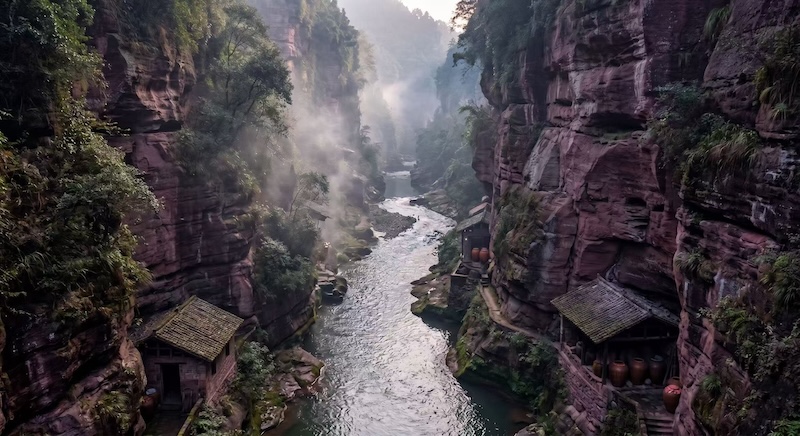
- Why did the 1970s "Moutai Relocation Experiment" fail so spectacularly? Because a premier commercial moat is not a chemical formula scrawled on a whiteboard; it is an asset deeply embedded in the geophysics of a specific site—the microclimate, the water filtered through purple sandstone, and the unique microbial colonies of the canyon. These natural conditions cannot be industrially transposed.
- How does geographic limitation translate into the ultimate tool for scarcity management? When the core production zone is irrevocably locked within a 15-square-kilometre canyon along the Chishui River, the capacity ceiling is dictated by nature. This physical inexpandability grants the product a "territorial dignity" (terroir) on par with the premier estates of Burgundy.
- How should investors re-evaluate "inimitable assets"? In an era where digitalisation can replicate anything, seeking out "geographically monopolistic" firms—those whose expansion is constrained by rigorous geographical, biological, or climatic conditions—is the most potent strategy to hedge against inflation and overcapacity.
If you were the CEO of a global pharmaceutical giant, you would know that patent protection is the lifeblood of survival. But what if a firm’s core "patent" were not a legal document locked in a safe, nor a molecular formula derived by elite scientists, but a river cutting through a canyon in Southwest China and an invisible microbial universe floating in the air? Modern business textbooks have indoctrinated us with the belief that all successful models must be standardised and infinitely replicable through technology. Yet, this behemoth, fermenting in the dim cellars along the Chishui River, has for half a century arrogantly mocked the industrial fantasy of replication.
The Natural Capacity Ceiling and the Scarcity Premium
For private investors and curious polymaths seeking monopolistic assets in global markets, understanding "inimitability" is the baseline of wealth defense. In the 1970s, an "off-site experiment" involving top experts attempted to break this monopoly using pure industrial logic. They took the original soil, raw materials, and every brewing process to build a 1:1 replica nearby. The result was a catastrophe: the resulting liquid simply lacked the requisite soul.
This cruelly proved that the permeability of the purple sandstone, the unique high-temperature, high-humidity microclimate of the canyon, and the generations of microbial flora are assets that even a Wall Street chequebook cannot buy. In the eyes of capital, an inability to expand is usually bad news; here, however, geographic limitation serves as the sharpest scalpel for scarcity management. When nature locks a company’s annual output while the hunger of global "old money" and new elites expands infinitely, the firm escapes the fate of a fast-moving consumer good and ascends to the status of a "geographically monopolistic asset" with absolute pricing power.
Strategic Alpha
|
The Dilemma |
The Strategic Play |
The Alpha |
|
The Myth of "Borderless Expansion": The belief that all successful models must replicate globally like software, with near-zero marginal costs. |
Embracing "Geographic Destiny": Identifying and anchoring those core production areas deeply dependent on specific soil, water, and microclimates—the ultimate source code that cannot be hacked. |
Constructing a physical abyss that competitors, regardless of capital, can never fill in an age of easily counterfeited supply chains. |
|
Viewing Capacity Constraints as Defects: Experiencing growth anxiety when unable to rapidly expand output during demand surges. |
Translating Constraints into "Territorial Dignity": Leveraging the capacity red lines drawn by nature to implement a Veblen-style quota system, mimicking the logic of prestige estates. |
Fundamentally inverting the supply-demand relationship, where waiting lists and quotas themselves become symbols of status for the consumer. |
|
Industrial Standardisation Over All: Attempting to use sterile labs and precision climate control to level the uncertainties of natural fermentation. |
Taming Rather Than Opposing Nature: Allowing uncontrollable microbial colonies to act as the "Chief Product Manager," branding minor natural batch variations as "gifts of time." |
Endowing the product with a soul that machines cannot simulate, capturing the extreme emotional premium of non-standard goods. |
To screen for such "geographic moats" from the vast global asset pool, one requires an ecological perspective that transcends traditional financial statements. The Niche Hunter acts as a patrolling falcon, precisely anchoring hidden monopolists whose unique terroir protects them from the industrial flood. Within the systemic think tank of the SOLOMOAT, we ensure decision-makers grasp this top-level commercial design where "Nature is a Shareholder," ensuring your balance sheet is built upon the hardest bedrock.
Technology can clone everything, but it cannot clone the microscopic universe precisely woven by sunlight and rain at a specific latitude and longitude. Some moats were dug by God himself.
We cordially invite you to join the SOLOMOAT to understand these unique Chinese champions.