How One-Person Companies Work with AI: Redefining Labor Relations
Aug 19, 2026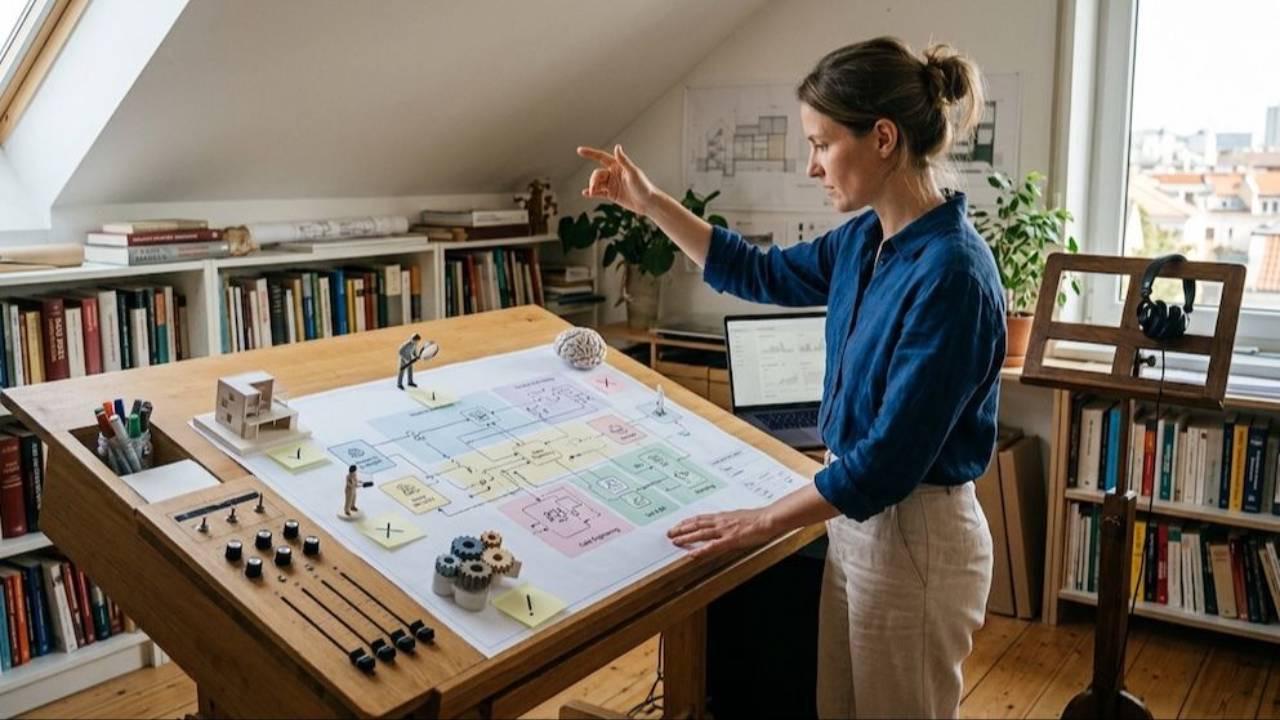
By Garbo Tian
💡 Core Strategic Takeaway
In an OPC, AI acts not only as a tool but as producer, staff, dialogue partner, and mirror. Greater automation shifts the founder’s work toward orchestration, monitoring, correction, and responsibility.
In the era of the One-Person Company (OPC), founders are not just utilizing new software; they are navigating an entirely new, unnamed labor relationship with Artificial Intelligence. When founders describe how they work with AI, they provide a self-portrait that reveals their anxieties, expectations, and their search for a place within this new dynamic.
💡 Quick Takeaways: Why the Human-AI Relationship Matters
What is the core shift? AI is no longer a passive, neutral tool with clear boundaries, but rather a dynamic presence that alternates between acting as a partner, a dominant force, and a mirror.
How does this impact founders? Instead of merely speeding up tasks, AI reorganizes the internal structure of labor, allowing ordinary individuals to continuously create complex systems on their own.
1. Beyond the "Tool": AI as an Organizational Team
In traditional labor relations, tools are passive mediums with clear functions. However, modern OPC founders rarely use the neutral word "tool" to describe their systems. Instead, they describe a dynamic workflow where AI takes on multiple roles:
The Idea Spark: In the creative phase, AI is used as a trigger to provide directions and possibilities.
The Producer: In the execution phase, AI takes on the role of completing specific tasks.
The Virtual Staff: Many founders treat AI as their actual employees, deploying specialized tools to act as research teams, UX designers, tech architects, coding engineers, and QA testers, while the founder merely acts as the "conductor".
2. The 4 Models of Human-AI Collaboration
Based on field research and founder interviews, OPC founders generally adopt one of four typical human-AI collaboration frameworks:
| Collaboration Model | Operational Strategy | Required Founder Skill |
|---|---|---|
| Full-Chain Hosting | Systematically handing over the technical aspects of the entire product development cycle to AI. | Strong "AI Project Manager" abilities, including clear task breakdown, prompt engineering, and output quality judgment. |
| Cognitive Companion | Treating AI as a dialogue partner to brainstorm, validate hypotheses, and reflect on blind spots (turning a "60-point intuition into a 120-point insight"). | The ability to deeply self-reflect and use AI to challenge assumptions rather than just execute commands. |
| Tool Combination | Forming personalized workflows by combining multiple tools (e.g., ChatGPT for text, Midjourney for images, Cursor for code, and Jimeng for video). | High competence in tool selection, integration, and managing individual production nodes. |
| Organizational Management | Assigning specific tasks like research, design, coding, and operations to different AI products as if they were functional employees. | Strategic delegation and "commander-level" oversight. |
3. The Paradox of Control
As Karl Marx described the externalization of skills to machines, we are seeing this process repeat so rapidly that it occurs entirely within a single person's career span. This speed creates a unique psychological paradox regarding "control".
Research shows that the deeper AI takes over core skills (such as generating 90% of a project's code), the more strongly founders—especially those from technical backgrounds—emphasize their "control" over the system in their narratives. Tech founders frequently assert that they are the masters of the AI, rather than the mastered. Meanwhile, content creators are more likely to embrace a co-creation dynamic, accepting AI as an active participant in their inspiration and expression.
Action Checklist: Optimizing Your AI Workflow
If you are building a highly leveraged OPC, use these steps to clarify your AI labor relationship:
Identify Your Collaboration Model: Decide whether you are acting as an "AI Project Manager" (Full-Chain Hosting) or a "Commander" (Organizational Management) to properly structure your daily operations.
Embrace the Cognitive Companion: Stop using AI merely for task execution; actively use its instant feedback to refine your intuition, push past creative blocks, and uncover strategic blind spots.
Manage the Control Burden: Accept that while AI drastically increases efficiency, it also shifts your primary workload to process management; you must continuously intervene, monitor, and correct the AI to prevent it from deviating.
❓ Frequently Asked Questions
Q: What are the four collaboration models?
A: They are full-chain hosting, cognitive companionship, tool combination, and organizational management.
Q: What is the paradox of control?
A: As AI takes over more core execution, founders often feel a stronger need to assert oversight and verify that the system still reflects their intent.
Q: How should founders optimize the relationship?
A: Choose a clear collaboration model, use AI to challenge assumptions, and design monitoring and correction into every critical workflow.
🎓 Build Your AI-Native One-Person Company
Explore SOLOMOAT Mini-MBA masterclasses for deeper frameworks on China, AI automation, business systems, and global growth.